Blog

The Problem with the Path of Least Resistance

You’ve had a long day at work. You come home to your other job: parenting and realize that your day is going to be even longer. All you can think about is quiet, some food, maybe a glass of wine and bed. All you can hear is squabbling and pleading. It’s like your kids can sense your weakened state & they pounce!

“Can I have some candy before dinner?”

“Can I watch an extra show?”

“Can I do my homework after my bath?”

“Can I hit my brother over and over again?”

You can feel your resolve crumbling. Anything to keep them quiet!

“Sure, have a lollipop!”

“A show?! Why not watch a movie?!”

“Homework? Whatever!”

“Hit your brother! I don’t care!”

And voila!, you’ve bought yourself some quiet time. But at what price? Tomorrow, the requests double. The hitting continues and is joined by some scratching too.

This is not to say that anytime you give in, you will immediately feel the consequences. And this is also not to say that you have to fight every fight. But just like that extra bit of dessert or those extra 20 minutes in bed before work, you will pay for this somewhere down the road. Sometimes the quick fix is your worst enemy.

But Katie, sometimes I just don’t have the energy or the time to do anything but the quick fix!

I hear you(!) and to this I say <ahem> that if you put in the hard work up front, things will be easier over time. Like my snazzy, unscientific chart here shows.path of least resistance chart
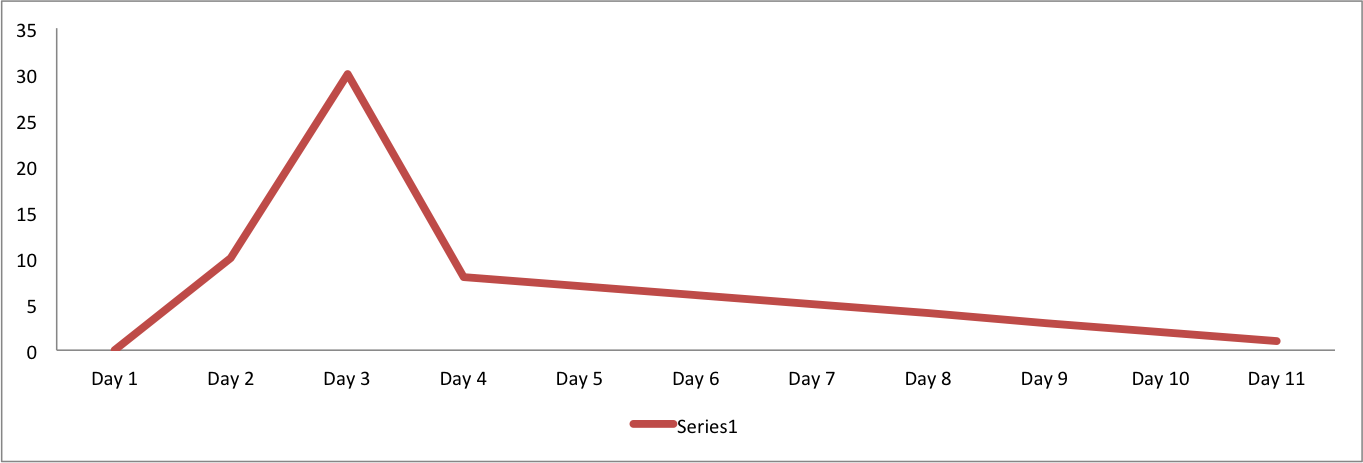
I know it doesn’t seem that pleasant to consider (and this is supposed to be the land of pleasant parenting after all), but after a few days of you sticking to your guns, your kids are going to stop asking about candy before dinner! And they may even quit asking to watch more TV than they’re allowed. If you take the path of greater resistance, you just may find that it was the path of least resistance in disguise. It looked very brambly and hilly and daunting, but after a little while of walking, you found that it was flat, wide and downright pleasant!

So before you give in and shake your head at yourself, think what the cost of your decision will be tomorrow. If it seems too high a price to pay, consider taking a different course & paving a new way forward.


Comparison: Hyping our worries about our kids

blue-ribbons“Well my son was reading by the time he was 9 and 1/2 months!”

“My daughter could sit up when she was just 5 months old!”

“My son didn’t start walking until he was 18 months!”

These are the urban legends and worries that all parents hear when talking with other parents. Everyone knows someone whose kid is lagging behind. Everyone knows someone whose kid is light years ahead. And we all compare those stories to our own dear ones. How are they faring when we put them next to their peers? That kid seems to be picking things up with more dexterity. That other kid appears to have much better penmanship.

WHAT DOES ALL OF THIS MEAN? ARE OUR KIDS FAILING AT THINGS? AND ARE WE FAILING THEM? AHHH!

Comparing our kids to their relative age groups is certainly a good way to gauge their general progress. The problem arises when we let these comparisons become the basis for our decision making for our kids. And when we let these comparisons sew seeds of worry within us. As we all race to the top in our ever competitive world, we want our kids to be able to scramble toward “success” just as well as the kid sitting next to them on the kindergarten rug.

I’m guilty of this syndrome too. I sometimes watch for “milestones” a little too suspiciously and take a little too much pride in bragging about my daughter’s ability to do something. Parents who flaunt their kids’ mastery of certain skills are just as culpable as parents who are fearful of their child’s lagginess. It’s difficult for us to change the culture of competition that we’re experiencing right now, but perhaps if we meet in the middle and all try to worry a little less about how our kids are progressing we might get somewhere. I know, easier said than done.

My one (perhaps misguided) tactic to combat my own feelings of ‘worry by comparison’ is to stay just ignorant enough of upcoming milestones that my daughter should be working towards. Sure I read parenting books and I have a vague idea of child development (she should walk…someday, right?), but the small specifics of how and when often vary so widely for different kids that clinging to these ages and stages DOES ME NO GOOD. I’m not saying that everyone should join with me in my blissful ignorance, but I am suggesting that we each find a way for ourselves to compare our kids to yardsticks and each other a little less. If we compare less, then our feelings of worry should inevitably decrease, yes? Maybe.

Who knows how much I actually know about parenting? But I don’t think that I’d be wrong in saying that parental worry does not increase a) a child’s success b) a child’s overall happiness & sense of well-being  c) the parent’s overall happiness & sense of well-being and d) the parent’s ability to make well-informed decisions about their child.

So before we move the chains to cover the next set of skills to worry over, maybe we should tone down our inner comparing voice and give ourselves and our kids a break.

Fighting the Fear

Concern for the safety of our kids is at an all time high. We worry about something happening to them that might hurt them. In order to prevent these “happenings” from…happening, we work to make our kids activities very ‘safe’. A possible result of this protectiveness is that we are raising more fearful kids.

I turned on the vacuum cleaner this morning while my daughter lay on the floor across the room. Her immediate reaction was…<scared face>! She thought about crying for a moment, while I reassured her that it was only noise. My initial thought was to turn the vacuum off and to make sure that she wasn’t afraid. Then I thought about what would happen if every time I turned on the vacuum, she cried and I didn’t vacuum. (Let’s be honest, it wouldn’t be too much different than now since the vacuum doesn’t get a ton of use) But I wouldn’t be able to vacuum when she was awake or then when she was asleep since it would wake her up. And eventually, I’d sell my vacuum and live in a dirty house. It’s not so important that I begin to work through her fears right this minute, but the longer that ‘irrational’ fears go unchallenged, the more cemented they become.

For example, I know a young man who used to be screamingly terrified of hand dryers in public bathrooms. At one point he would have rather wet himself than even enter a bathroom that had one. Because his fear had been left unchecked (and even encouraged), it became bigger and bigger until it became a problem for him to use a public bathroom. Uh oh. My fear eventually became that we’d find a hand dryer somewhere and a scene would ensue. Trying to control his environment so that he would not have to eventually face his fear only lead to more fear. The first few times that I warned him and then used the dryer myself, I just had to live with the echoing bathroomy screams that followed. But we practiced it often enough that eventually he became a bit more comfortable with them and at least wouldn’t run yelling from the bathroom if he saw one.

The general thinking is that if kids are afraid of something, they don’t need to do it. Depending on the circumstance, this can, of course, be true. If your child isn’t ready to jump off of the diving board at the swimming pool, that’s ok. Encourage them to jump from the deck into the pool first. Just as we eventually take their training wheels off of their bikes, helping them to face their fears, not avoid them indefinitely is a sign of maturity and growth- for both them and us!

If we let fear become the narrative and encourage it in our children by worriedly narrating their play with “Careful!” and “Watch out!” and “Ahhh! You fell down!”, we will be setting the stage for some entrenched fears and problem-causing scenarios.

We have to face our fears for them while they face their own fears.

I’ll never forget the day that hand dryers ceased to be the enemy. He was proud and so was I. Together we faced our fears.

Drive-By Parenting

It’s awfully quiet in the living room.  Yet you know that’s where your two kids are playing. Your first thought is to yell, “Everything ok in there?” Or rush into the room just to check up on them. But then you reconsider. You decide to do a quick drive-by instead.

[cointent_lockedcontent]

So why not just ask them what’s going on or run in to check? Why be sneaky?

#1 You want your kids to feel that you trust them

If every time they’re quietly reading a book, you interrupt them to ask what they’re doing, they’re going to quickly get the impression that you don’t trust them…even to read. If we always want to know what they’re “up to,” we won’t be allowing them privacy and autonomy. Telling them that they’re always answerable to us and not themselves is not the message that we want to send.

By inventing a chore that takes you into the living room, but doesn’t include staring at them or even talking to them necessarily, you can assess the situation without letting them know that you don’t actually trust them. Be nonchalant. Whistle while you look for that imaginary book. They might not even notice you’re there if they’re really involved in something, which means you can come back and check again if you need to without raising their hackles.

#2 You’d like to stop being annoying (to them & to ourselves)

Every time I hear myself saying those tried and true parental phrases (Don’t run! Don’t eat your boogers! Stop biting your sister!), no matter how necessary they are, I am appalled to hear how much of an adult I am. Our own voices can become annoying to us and to them. And when this happens, our words lose their gravitas. We become background noise. That’s why you have to say “Don’t run!” 27 times, because they’ve practically stopped being able to hear you.

When you become a quiet peruser of your kids, instead of a raucous interrupter, you catch them doing all kinds of things. And most of them aren’t even bad! You can quietly watch them try to figure out how to put a puzzle together. You can sometimes catch snippets of ‘pleases’ and ‘thank yous’ being exchanged among siblings. And sometimes even when they are doing something a bit naughty, you can watch the deftness that it takes to climb on top of the table to retrieve their lost crayon.

#3 Check-ins can be sweet instead of sour

If we’re always yelling from the next room for them to behave, keep it down or confess their current naughtiness, check-ins are eventually going to be instantly confrontational. When you enter a room, they’ll expect a lecture (that they can ignore). They’ll think that you’re looking to catch them doing something they shouldn’t be. Yick. Doesn’t sound that fun.

Instead, you can go into the living room to find your chapstick and give them a kiss along the way. Now you’ve checked on them and given them a little love. Or if you’re making dinner and you haven’t yelled out to them in a while, they just might come into the kitchen looking for you. Maybe they even want to help with dinner (What?!).

So next time you’re curious as to what those kiddos are up to, simply go to check on them without checking on them. A little drive-by parenting can be nicer than it sounds.

[/cointent_lockedcontent]

Private Parenting

Everyone knows the adage “It takes a village to raise a child.”

Generally speaking, Americans value the influence and support of extended families, religious communities and peer groups in the raising of our kids. But even in the best of cases, we can see the opinions and actions of these others as meddlesome and “incorrect” for our own kids. We have our own thoughts, views and sometimes even philosophies of child-rearing. And views that don’t jive with our own can make us defensive and disinterested. Parenting our own children has become a pretty private affair. After all, who are you to tell me how to parent? It’s nobody else’s business how we run things at our house. Our individual choices and our “best fit” philosophies have won the day in our modern parenting movement. We encourage individuality and specialness in our kids and we sew those seeds early on by parenting them in our own individual ways.

In contrast, in her book Bringing Up Bebe, Sharon Druckerman recounts many conversations with Parisian parents who seem to have very similar ideas on how to raise their children. Almost all of these anecdotes include parents unapologetically saying that they are the bosses in their houses. They also tend to agree that guilt doesn’t have a very useful place in parenting (wha?!!). The same is true of Christine Gross-Loh’s research for her book Parenting Without Borders. When her family lived in Japan, there was a general societal expectation in their community that young kids should run errands for their parents. Everyone agreed on this and therefore watched out for children who were out by themselves, but also respected their ability to be safe on their own.

We don’t seem to have too many agreed upon ways of dealing with our kids collectively anymore. And our individual opinions are often indelible.

“I think that saying ‘no’ to my child is going to stunt them in the long run.”

“I think that letting my child decide when she’s ready for bed is a good way to teach her autonomy.”

“I don’t want to indulge my kids or spoil them, so I say ‘no’ to them all the time.”

“I’m the one who decides what they eat, when they sleep and who they can play with.”

“I think that holding my baby almost all of the time is the best way for them to feel secure and loved.”

“I let my child cry themselves to sleep.”

With all of these differing opinions, it’s easy to see why parents might feel isolated or left out (the bad side of “privacy”). Lacking support and feedback on our parenting can lead us into well-worn and ineffective ruts. When we are defensive and isolated about our “right” ways of doing things, we cut off access to most outside support. Plus, policing our kids’ lives so that the things that they learn and the people with whom they come in contact fit with our parental philosophies is exhausting. We have to find the right school, the right activity, the right social group, the right words and tone of voice. Phew.

Please don’t misunderstand me. I think that I have everything figured out and that nothing will flummox me as a parent. (Ha!) And because I often think that I know what’s “best,” I’m skeptical of hearing others’ thoughts. Giving advice is tricky and getting it is often unwelcome. I’m not advocating that we dish out our best nuggets of knowledge to every harried parent that we meet or brag about our own smooth sailing. I am simply suggesting that we think again of that imaginary village where everyone is purported to be raising each child. I have to trust others in my community to have mine and my child’s best interest at heart whether we agree on how long breastfeeding should go on or what education philosophy is best for kids. Finding common ground and building from there is our best hope to get and receive support in the little villages that we each live in.

Parenting doesn’t have to be such a private thing if we don’t want it to be.

itTakesaVillage