Attend-Ignore-Attend-Ignore

My daughter can sit up and reach for things. Woot. Braggin’! When we spend time with other kids who are around her age, she sometimes gets complimented on her skills. Recently, a mom jokingly told me that she was jealous and asked how I “got” her to do these things. I responded jokingly, but truthfully, “Neglect.”

neglect

As we continue to swing from one side of the parenting pendulum to the other, I find myself (surprisingly?) championing the idea of letting kids be. I like the balance that Catherine Newman seems to have struck in her NY Times parenting blog post, Give Kids Your Undivided Attention- Or No Attention At AllShe suggests that we fully attend or fully ignore our kids. And in these days of pushback to helicopter parenting (this didn’t used to be a bad word!), I think we all could use a little reassurance that letting go doesn’t result in a) our kids continuously getting hurt b) our kids never learning anything c) our kids not knowing that we love them- which were, perhaps, some of the worries that made us hover in the first place.

My daughter is sleeping now, so I can fully attend to my writing, but when she is awake, I often feel a guilty pull to be near her even while she entertains herself happily with her toys. Am I narrating her play enough? Will she hear those extra 30 million words when she’s young if I’m ignoring her? I work to watch and not intervene all the time. But it is often a conscious slow-down rather than my first instinct.

If we allow ourselves to name our computer time or reading time or phone time while our kids take care of themselves, maybe we’ll be more able to let ourselves off the hook. It’s not bad if I’m doing some computer work while she’s awake and around. It’s just better for both of us if I’m fully engaged in whatever it is I’m doing. That way she can get used to doing certain small things on her own, like reaching for her toys that have gotten away. When she knows that I’m not paying attention, she manages things for herself much better than when I’m present. When I sit down on the floor with her to play or watch her, she almost always needs rescuing from me when she didn’t before I got there. She “asks” to be picked up or repositioned. She whines for something she can’t reach. This is not to say that I am not going to spend time with her simply because she gets more needy when I’m around. But it does underline that her being on her own a bit is good for her, even at her young age.

My parents have often quoted the term “benign neglect” to me as the vague style of parenting that they used when my brother and I were young. So while I joke about my neglectful parenting, I think that there may be some merit to the idea.

The Problem with the Path of Least Resistance

You’ve had a long day at work. You come home to your other job: parenting and realize that your day is going to be even longer. All you can think about is quiet, some food, maybe a glass of wine and bed. All you can hear is squabbling and pleading. It’s like your kids can sense your weakened state & they pounce!

“Can I have some candy before dinner?”

“Can I watch an extra show?”

“Can I do my homework after my bath?”

“Can I hit my brother over and over again?”

You can feel your resolve crumbling. Anything to keep them quiet!

“Sure, have a lollipop!”

“A show?! Why not watch a movie?!”

“Homework? Whatever!”

“Hit your brother! I don’t care!”

And voila!, you’ve bought yourself some quiet time. But at what price? Tomorrow, the requests double. The hitting continues and is joined by some scratching too.

This is not to say that anytime you give in, you will immediately feel the consequences. And this is also not to say that you have to fight every fight. But just like that extra bit of dessert or those extra 20 minutes in bed before work, you will pay for this somewhere down the road. Sometimes the quick fix is your worst enemy.

But Katie, sometimes I just don’t have the energy or the time to do anything but the quick fix!

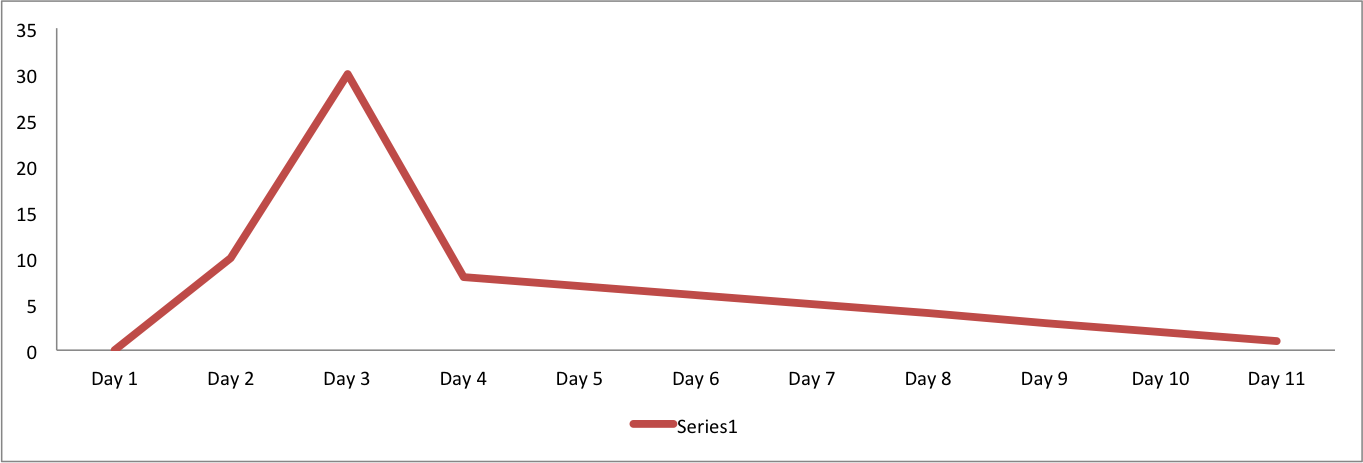
I hear you(!) and to this I say <ahem> that if you put in the hard work up front, things will be easier over time. Like my snazzy, unscientific chart here shows.path of least resistance chart

I know it doesn’t seem that pleasant to consider (and this is supposed to be the land of pleasant parenting after all), but after a few days of you sticking to your guns, your kids are going to stop asking about candy before dinner! And they may even quit asking to watch more TV than they’re allowed. If you take the path of greater resistance, you just may find that it was the path of least resistance in disguise. It looked very brambly and hilly and daunting, but after a little while of walking, you found that it was flat, wide and downright pleasant!

So before you give in and shake your head at yourself, think what the cost of your decision will be tomorrow. If it seems too high a price to pay, consider taking a different course & paving a new way forward.

Comparison: Hyping our worries about our kids

blue-ribbons“Well my son was reading by the time he was 9 and 1/2 months!”

“My daughter could sit up when she was just 5 months old!”

“My son didn’t start walking until he was 18 months!”

These are the urban legends and worries that all parents hear when talking with other parents. Everyone knows someone whose kid is lagging behind. Everyone knows someone whose kid is light years ahead. And we all compare those stories to our own dear ones. How are they faring when we put them next to their peers? That kid seems to be picking things up with more dexterity. That other kid appears to have much better penmanship.

WHAT DOES ALL OF THIS MEAN? ARE OUR KIDS FAILING AT THINGS? AND ARE WE FAILING THEM? AHHH!

Comparing our kids to their relative age groups is certainly a good way to gauge their general progress. The problem arises when we let these comparisons become the basis for our decision making for our kids. And when we let these comparisons sew seeds of worry within us. As we all race to the top in our ever competitive world, we want our kids to be able to scramble toward “success” just as well as the kid sitting next to them on the kindergarten rug.

I’m guilty of this syndrome too. I sometimes watch for “milestones” a little too suspiciously and take a little too much pride in bragging about my daughter’s ability to do something. Parents who flaunt their kids’ mastery of certain skills are just as culpable as parents who are fearful of their child’s lagginess. It’s difficult for us to change the culture of competition that we’re experiencing right now, but perhaps if we meet in the middle and all try to worry a little less about how our kids are progressing we might get somewhere. I know, easier said than done.

My one (perhaps misguided) tactic to combat my own feelings of ‘worry by comparison’ is to stay just ignorant enough of upcoming milestones that my daughter should be working towards. Sure I read parenting books and I have a vague idea of child development (she should walk…someday, right?), but the small specifics of how and when often vary so widely for different kids that clinging to these ages and stages DOES ME NO GOOD. I’m not saying that everyone should join with me in my blissful ignorance, but I am suggesting that we each find a way for ourselves to compare our kids to yardsticks and each other a little less. If we compare less, then our feelings of worry should inevitably decrease, yes? Maybe.

Who knows how much I actually know about parenting? But I don’t think that I’d be wrong in saying that parental worry does not increase a) a child’s success b) a child’s overall happiness & sense of well-being  c) the parent’s overall happiness & sense of well-being and d) the parent’s ability to make well-informed decisions about their child.

So before we move the chains to cover the next set of skills to worry over, maybe we should tone down our inner comparing voice and give ourselves and our kids a break.

The trouble with saying “No!”

Just yesterday I was hanging out with a young friend of mine. She’s 2 and a half and we were looking at a holiday train display. Exciting!! So exciting in fact that lots of other children and their grown-ups were there. Everyone was vying for an optimal view and button pushing position (to make things go round or light up), including my young friend. Naturally this jockeying occasionally led to some pushing and pulling by the kids who were there enjoying the festivities.

Forgetting my own pontifications for a moment, I found myself pulling my young friend aside when I would see some pushing. I asked her not to push, explaining that we would have to say goodbye to the trains if she pushed other kids. Inevitably there was more pushing and I picked her up, telling her why we had to say goodbye to the trains (for a minute at least). I was trying to make a link between getting to enjoy the trains and not pushing. When pushing happens, we have to step away and not do something fun for a minute. Now this is not entirely wrong when trying to solve the problem. But I forgot one crucial thing until nearly after the fact. I did not offer her a replacement behavior or a behavior that I’d like to see instead of pushing. I asked her not to push, but I didn’t tell her what to do instead.

Lucky for me, I had the opportunity to remember when she was playing at a train table a little while later and pushed a child who had rather forcibly taken what she was playing with. This wasn’t my finest moment either. I swooped in, picked her up, asked her to apologize and immediately left, still talking about “no pushing, when you push, we have to stop playing” etc.

Only once we were safely in the car did it occur to me to practice with her what she should do instead of pushing. She’s 2 right, so I know that long explanations and out of context lessons might be pointless, but I was hoping that since we had just left, I could still squeeze some life out of “the incident.”

So the conversation went something like this:

Me: You have to use nice hands when you’re playing with other kids. Nice hands take turns and share. If someone takes a toy from you, you can say “My turn!”

Child: My turn!

Me: Right! And if they don’t give it back, you can say, “Katie! My turn!”

Child: Hatie! My turn!

Now I know that this tiny little on-the-go lesson is not going to stop the pushing that occurs when frustration rises in this little girl for whatever reasons. But it’s important to lay the groundwork somewhere. We can now have more conversations about nice hands. I can show how “nice hands” play, share and take turns. Her stuffed animals can have “nice hands.” I can also commend her when I see her using “nice hands” instead of force!! I, hopefully, have created an opportunity to praise the right behavior rather than simply negating the wrong one. Reinforcing the right behavior lets kids know what they should be doing.

If only I had thought of it earlier. Ah well. Practice makes perfect?