
Is Google a new parent’s worst enemy?

google logo

I googled something this morning. Something about my kid. It’s the first time I’ve googled something baby related since…2013? The question was simple: How much fish is safe for babies to eat? I looked at the results for about 4 minutes, reading some of them out loud to my husband. Most results were pretty measured: “Don’t eat this kind of fish, and only eat this other fish in moderation.” But others could easily lead to worry, “Too much mercury in infants can lead to cognitive impairments, attention problems, language delays, etc.” This is just a small example of the wonders and worries that google can provide for new parents. Ack!!

How many parents have googled something to find that their search points toward an autism spectrum disorder? How many parents have worried themselves with googles on babies’ eyes not pointing in the same direction? How many parents have ascertained that their child is suffering from a real medical crisis because they haven’t pooped in 3 days?! More Ack!!!

It makes sense that we want to know as much as we can. We are curious beings by design and the internet has allowed so much knowledge to be just a click away. Our phones and computers call to us to be used to play games, check messages and diagnose symptoms. Why should we not use the instruments at hand to gather as much information as possible? I would say that it’s the same reason we shouldn’t try to convince our doctor to put us on that anti-anxiety medication that we saw advertised on TV. More information in incapable hands is not a good thing. In fact, it often works against us. We paint incomplete and worrisome pictures that only increase our anxiety levels (obviously why we need to prescribed the Zoloft). I’m getting stressed just thinking about this.

So how do we combat the desire to google, “Is it normal that my baby sleeps with one eye open?!” and all of the other questions that we ask ourselves on a daily basis?

I only know why I keep google out of my child-rearing, so I’ll let you in on my reason.

I don’t want to increase my anxiety level because I don’t like how it feels to be anxious.

When I notice a small rash on my daughter’s face, I first ask myself how she seems. I try to slow down enough to take in her overall mood and well-being. Then I ask my husband to take a look at it and see if he thinks it’s anything to be concerned about. Then we usually decide to wait a little while to see if it fades or gets worse. All of our “braking” procedures seem to be working so far because none of her rashes have turned out to be scabies. I am all too aware that if I let myself fall down the rabbit hole of rash searches online, I would come out scarred myself. My heightened worry wouldn’t help my daughter either. I would simply freak out over every little sneeze, bump and scratch.

If something is truly worrisome, then I will consult our pediatrician, not the internet.

Until then, I’m going to use the internet to distract and waste my time, but I’m not going to allow google to convince me that my daughter has leprosy.

I Thought Everything Would Change

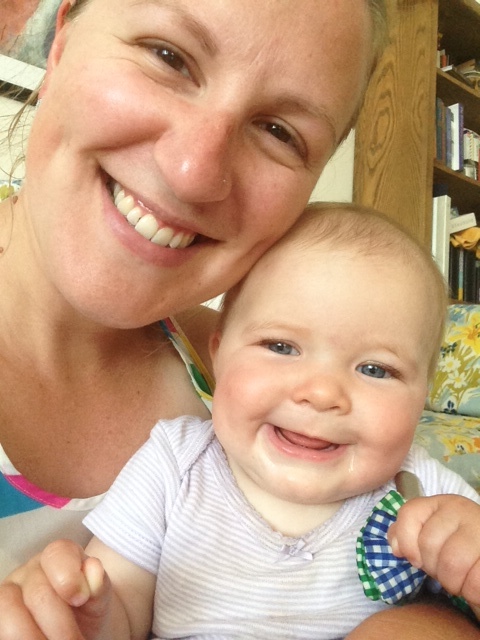
Mama & NoraWhen speaking with parents (prior to becoming a parent myself) about the ups and downs of life with kids, there was often an unspoken theme: You’ll understand once you have some yourself.

As a parent educator, who did not have kids, I always had to hedge my bets and say, “I can’t fully understand what you all go through as parents…”

There is a line that divides the “haves” and the “have-nots” because there is an overwhelming assumption that you just don’t get it until you’re a parent too.

So when I became a parent, I waited for lightning to strike. I waited to become different, feel more love than I’d ever felt before or hurt over someone else’s pain far more than my own. Then lightning struck in a different way, with the realization that I actually had had a pretty good idea of what it was like to be a parent even before I was one. Blasphemy! And even more, that I was still, fundamentally, the same.

I have read over and over again that there are no words to describe the Herculean task that is parenting. It is sooo hard and yet sooo rewarding. I’ve read how much people’s lives and views and priorities have changed. Plus there’s always the threat of never sleeping again!!!!

Since this is the overwhelming narrative of modern parenting (similar to the knee-jerk trite-ness of “Teachers are our real <underpaid> heroes.”), we basically all subscribe to it whether we’re conscious of it or not.

But I have some confessions to make regarding my pre and post parenting experiences.

#1 It’s never easy to listen to a kid cry, but it’s not so very different for me to listen to my own cry rather than someone else’s. I thought that there would be a magic string inside me that would get wickedly pulled when listening to my daughter cry. Turns out that that’s not true. The real reason that it eventually bothers me is because I hear it more often than I’ve ever heard any other kid cry.

#2 I thought I would love her more than anything ever when she was born. That’s what was supposed to happen, right? But that’s not what happened. A switch didn’t get flipped in me. I didn’t instantly understand, identify and embrace my new role as mother. I didn’t “fall in love” with her. My love for her grew over time and with care. But, it does not suffocate me. It does not eat me alive. I am not kept awake at night with love-filled worries and hopes for her. I love her, a lot, but happily for me, it has not entirely eclipsed my vision.

#3 Caring for and about any kid breeds the same kind of love that I feel for my daughter. It’s not different than love I’ve felt for other people’s kids. With added responsibility and connection, there is more of it, but it seems to be more of the same- not sparkly, magical, all-new love.

These revelations could seem sad to some folks, but I have to admit that I’m so glad to still have my center of gravity intact. I’m glad to still be me.

So while I am not trying to replace the adage of “You’ll understand once you have kids,” I’d like to add to it the possibility that your understanding might stay the same. And everything might not change for you like it’s been foretold.


And That’s My New Philosophy!

When I got involved in the parenting blogosphere a few years ago, I had no idea that so many other people had already thought to write about parenting issues. I was savvy even then.

So now it’s a couple of years in, I’ve read many a parenting book, taught parenting classes, had consultations with parents on what to do with challenging behaviors and I still am rounding out my knowledge base and my opinions. But I find a “new” trend to be a little alarming even though it has to do with people following parenting advice (which ostensibly I should love): having a parental philosophy.

Why the concern, Katie? There’s been a lot of chatter on the web about RIE parenting of late & “free-range parenting“, which both seem to be on the rise as a response to the ideas of concerted cultivation and attachment parenting (don’t forget “helicopter parenting”). I think that if you read my blog at all, you’ll be able to guess which way I tend to lean in this debate, but I’d like to take a different path if I may.

I’d like to make an argument for NOT HAVING A PARENTAL PHILOSOPHY.

I recently read a post defending RIE parenting and explaining it’s basic tenets. After having digested the <albeit> rather sensible information that I found there, I couldn’t get rid of one pesky problem with it. The author of the post cited herself as being an “RIE parent” and classified little ones as “RIE kids.” What’s the problem with that Katie? Defining yourself by the way that you parent leaves very little wiggle room for you to try something new. If you want to go off-book but know that it will be going against the rules, you might not break with your philosophy. But what does this matter if the philosophy is the best one around? I would wager that before our kids are parents, there will be even more, as-yet unthought of parenting philosophies. So who’s to say that any of them are the best? In fact, many who ascribe to a certain philosophy, much like religious fanatics, are truly convinced that there’s is the best (read: only) way to parent. As we more narrowly define ourselves, we make it harder to branch out, see others’ points of view and even grow personally.

I was recently informed of a play group being formed in my neighborhood with the intent of being a RIE space for kids to learn and develop in. Again, this sounds like an idea that I can get behind, but…I still have reservations. I like the idea that parents there won’t be hovering over their kids. Thumbs up. I dislike the idea that I have now entered a space that is so homogenous. We could all stand around and pat each other on the backs for not screaming when our kids tripped and fell (don’t get me wrong, I love a back-pat), but how is that depiction of the world realistic? The realistic world is that you’ll go to the park and your kid will fall and other parents will worry over her while you stay seated. If we try to recreate the world in the image of our philosophy, where will it end?

I’m not saying don’t have opinions or don’t read things or don’t like something more than something else <cough, RIE, cough>. I am saying that keeping an open mind is one valuable lesson that we’d like to teach our kids. Accepting other people and their ideas- another good one. Let’s tread lightly when we feel that our philosophy being threatened means that our way of life is being threatened.

If we all just loosened up our grasp on OUR PHILOSOPHIES(!), we might find that not having one is the best philosophy of all.

Frustration of Wants

How many times in a day might you say ‘no’ to your kids? I think it’s safe to say that they want a lot of things.

They want to poke the dog in the eye. They want to eat sweets until they feel ill. They want to stay up too late. They want to get up too early. They want to do anything besides homework. They want to do what they want to do…not what we ask them to do.

And, as parents, we work to keep these wants in check, hopefully teaching them not to be overtaken by them as they grow older (ala Veruca Salt).  Many parents think that having their wants “frustrated” by us is good for them. Our “no’s” are like vitamins for them. It helps them realize that they can’t have the world, right now.

On the other hand, parents find our wants are frustrated by our kids too.

We want to sleep in. We want some PEACE AND QUIET! We want to be able to poop without interruption. We want to have kids who love and respect each other. We want to have some adult time and freedom.

But we rarely view our kids’ actions as helpful to us in not letting us get too much of what we want. If it’s a good thing for us to teach them not to get what they want all the time, can it be a good thing for them to apply this same pressure to our lives?

Even if  we (parents) have kinds who always mind us and who always play well with others, living with them is still a continuous act of compromise. We work to have our needs met regularly, as well as some of our wants. And we work to meet our kids needs regularly and give them some of what they want.

It’s easy to think of kids as the thing that ended our lives of fun, our availability and our stamina. But we can also look at them as vitamins for us to help us figure out what we really need and rid ourselves of some unnecessary wants- just as we are the frustraters of their wants as well.

Attend-Ignore-Attend-Ignore

My daughter can sit up and reach for things. Woot. Braggin’! When we spend time with other kids who are around her age, she sometimes gets complimented on her skills. Recently, a mom jokingly told me that she was jealous and asked how I “got” her to do these things. I responded jokingly, but truthfully, “Neglect.”

neglect

As we continue to swing from one side of the parenting pendulum to the other, I find myself (surprisingly?) championing the idea of letting kids be. I like the balance that Catherine Newman seems to have struck in her NY Times parenting blog post, Give Kids Your Undivided Attention- Or No Attention At AllShe suggests that we fully attend or fully ignore our kids. And in these days of pushback to helicopter parenting (this didn’t used to be a bad word!), I think we all could use a little reassurance that letting go doesn’t result in a) our kids continuously getting hurt b) our kids never learning anything c) our kids not knowing that we love them- which were, perhaps, some of the worries that made us hover in the first place.

My daughter is sleeping now, so I can fully attend to my writing, but when she is awake, I often feel a guilty pull to be near her even while she entertains herself happily with her toys. Am I narrating her play enough? Will she hear those extra 30 million words when she’s young if I’m ignoring her? I work to watch and not intervene all the time. But it is often a conscious slow-down rather than my first instinct.

If we allow ourselves to name our computer time or reading time or phone time while our kids take care of themselves, maybe we’ll be more able to let ourselves off the hook. It’s not bad if I’m doing some computer work while she’s awake and around. It’s just better for both of us if I’m fully engaged in whatever it is I’m doing. That way she can get used to doing certain small things on her own, like reaching for her toys that have gotten away. When she knows that I’m not paying attention, she manages things for herself much better than when I’m present. When I sit down on the floor with her to play or watch her, she almost always needs rescuing from me when she didn’t before I got there. She “asks” to be picked up or repositioned. She whines for something she can’t reach. This is not to say that I am not going to spend time with her simply because she gets more needy when I’m around. But it does underline that her being on her own a bit is good for her, even at her young age.

My parents have often quoted the term “benign neglect” to me as the vague style of parenting that they used when my brother and I were young. So while I joke about my neglectful parenting, I think that there may be some merit to the idea.