How was school today?

It’s 3:30. Your kids just got home from school. They’ve hung up their things, unpacked their bags, put their shoes where they belong. Wonderful! All of those routines are working well.

Since you don’t have to nag anybody, you ask them how their day was instead. Novel idea. But…your question is met with a) silence, b) a shrug, c) a grunt or d) “Fine.” Every parent has encountered this situation and what often ensues is a parental version of 20 questions (I find myself playing this one-sided game too often as well).

“Did you play with your friends?”

“What was for lunch?”

“How did math go?”

“Was Jessie in school today?”

“How was Ms. Jackson?”

“Did you have fun?”

I have run up against this problem and heard variations of it enough to wonder if there isn’t a better way to encourage kids to share. I still find myself getting a little annoyed with my parents if I feel like I’m being interrogated. So I thought and thought…and came up with an idea!

Why not give our kids conversation prompts similar to the writing prompts offered at school?

“Today, I saw…”

“Today, I smelled…”

“Today, I talked to…”

“Today, I felt…”

“Today, I heard…”

“Today, I laughed because…”

“Today, I learned…”

If we take part in this activity and model it for our kids, it might encourage them to think about the things that they experienced during the day. It certainly would require more than a ‘yes’ or ‘no’ from them in response to one of our questions.

Maybe try it out as part of an afternoon snack routine. You can be silly with your thoughts too so that everyday doesn’t have to be a deep exploration of emotions. It’s just a good start for your child to talk to you about their day and their experiences.

“Today, I smelled the flowers blooming outside.”

Judgment Day: Criticizing Parents

The “modern parenting” landscape is awash with advice, tell-alls, no-nos, craft ideas and stories of real life. Two weeks ago another look at a modern parent garnered a lot of buzz and a lot of scrutiny. Dara-Lynn Weiss wrote a piece for Vogue about the year long weight-loss plan/diet that she put her 7-year old daughter on. This piece has received so much attention (almost all of it negative), that it got me thinking about criticism and judgment, of both parents and kids.

So, have these thoughts ever occurred to you?

1.) You’re in a store where a kid is screaming and crying. The parent doesn’t seem to be doing anything to help calm the child down. What’s the matter with that parent? Why aren’t they trying to get the kid quiet?
2.) You’re in a store where a kid is screaming and crying. The parent is also yelling and being forceful with their child. What’s the matter with that parent? Don’t they know that yelling won’t solve the problem?
3.) You’re in a store where a kid is running around willy nilly. The parent is asking them to stop and quiet down. The child doesn’t seem to be listening. What’s that matter with that parent? Why aren’t they making their kid listen to them?

Or have these thoughts ever occurred to you?

1.) You’re in a store where your kid is screaming and crying. You’re trying to ignore their outburst as a way of dealing with it. But while you do this, you’re sweating and feeling that you should be able to control your child better than this. Bad Parent!
2.) You’re in a store where your kid is screaming and crying. You’re trying to subdue them with the methods that you normally use, but things aren’t going well. You’re starting to lose your temper. Oh no! Bad Parent!
3.) You’re in a store where your kid is running around willy nilly. They have a lot of excess energy and you want them to be able to get out some of their wiggles before you head to the library. But you feel that they should be listening better. What to do next? Bad Parent!

Parents today can be in the dangerous and isolating position of feeling judged by passers-by, family, friends and themselves. Feeling judged is one of the things that people are supposed to be impervious to once they become parents. The familiar motto is something like, “If it’s in the best interest of my kids, then I don’t care what others think.” {Incidentally, the phrase “best interests of the child” indicates the factors taken into consideration by the courts when making decisions in child welfare cases.} I myself have encouraged parents to follow their own internal voices and try to ignore looks from people in public while they discipline or attempt to calm their children. It’s not an easy feat. Feeling judged by yourself for some sort of parental “ineptitude” is another very real danger.

I would argue that the responsibility of overcoming feelings of judgment (both from internal and external sources) does not rest solely on the parents. As we (members of society) continue the cycle of thinking that we know what’s best for other people’s children, we will continue to judge those people for not acting in different ways. And parents will continue to judge themselves as well.

The same website that first called foul on Dara-Lynn Weiss has also published an admonition of those of us who are “shaming” Ms. Weiss with our criticism. It rightly points out that the criticism that is being flung at Ms. Weiss can be equated to the criticism that she doled out to her daughter while trying to change her eating habits. If we (adults!) continue to judge parents so harshly and so loudly for their “failings”, then what messages are we passing on to their kids and ours? Is the moral of the story that judging others is simply our right or responsibility? If so, then we will only be encouraging that behavior in our children as they grow and become more vocal; teaching them to use their newfound voices to criticise.
It’s difficult to stop yourself from judging others, but if you find yourself in a store with a screaming child nearby (be it yours or someone else’s) TRY to restrain yourself. If not for the parents or yourself, then do it for the kids.

GUEST AUTHOR: Temper Tantrums!

Hello everybody. I asked one of my best friends, Caitlin, to be a guest author for Kid Whisperer and share some of her prodigious knowledge with us. Not only do I like her a lot, she’s also a super smarty pants. Caitlin taught in NYC for 5 years before heading west to be a PhD candidate at the University of Oregon in Special Education. And here is what she has to say about temper tantrums!


You’re in line at the grocery store waiting to pay. You’d hoped it would be a quick trip, suddenly, you sense things might not go your way:

Mom, I want these Fruit Loops!

No buddy, those aren’t healthy, and we’re just picking up dinner. It’s time to pay.

But I want them!

I understand, but the answer is no. Go put those back please, and let’s go.


You see it coming. You don’t know how to stop it.

It’s not fair!! I want them! You NEVER let me have them!


It starts with foot stomping, the fists are balled, the sirening yowl, tears, and screaming accusations.

I want them! I need them! Why can’t I just have them?!?!?! You are SOOOOOO mean!


It’s here: The Temper Tantrum.

You feel the eyes of the cashier, the judgment of the mother behind you with the perfectly quiet little girl happily hugging her box of shredded wheat. You know you have to act, but what to do? You want to be cool, calm, collected, but firm. But you’re next in line, and the screaming is so obnoxious. What to do?? Do you squash it, put forth the face of discipline? Do you just scoop her up, abandon your groceries, and retreat to the car? Do you just buy the Fruit Loops? Do you ignore her, and all the stares, and go to your Zen spot?

What to do???

It turns out that none of those (completely natural) instincts will get you very far when dealing with a temper tantrum. When a child is spiraling out of control, she simply isn’t going to receive the message from any lessons or clearly given consequences. And buying the Fruit Loops just lets her know that any time she’s not getting her way, all she’s got to do is throw a tantrum, and you’ll give in. Ignoring her won’t help either, because she’s clearly losing control, and needs some help. Scooping her up and leaving might be tempting, but then you have no groceries, and you’re still giving in to the tantrum.

Rather, the best way to deal with a tantrum is to calmly disengage, and focus on de-escalating.

But what does that mean?

It means that, for the moment, you ignore the judgments, you ignore the fact that this is unacceptable behavior, and you recognize that your child isn’t in a healthy place. You talk her down. This doesn’t mean that you give in – we’ll get to consequences later – or give her all kinds of positive attention for the inappropriate behaviors, but rather that you deal with the situation in front of you as it is – a kid in the midst of a behavioral crisis.

So what does that look like?

A tantrum is a loss of emotional control. So de-escalating a tantrum is a process of helping a child regain control. It helps to acknowledge how the child is feeling, and give her clear steps to take toward regaining control herself.

Wow buddy, you really are upset about these Fruit Loops.

Are you feeling angry?


At this point, it might help to physically move to kid-level, and speak in quiet tones, modeling calm behavior.

I can see that you’re really mad, and I want to help you figure this out.

But it’s really hard for me when you’re yelling and screaming. Let’s try taking a few deep breaths and see if we can figure this out.


Praise the child for taking a deep breath. If she’s not buying that, provide a clear choice, but still gently move toward de-escalation.

I know how mad you are. We’re going to figure this out, but we have to be able to talk to each other. Let’s find a way to calm down. Would you like to take a drink of water or count to ten?


Maybe at this point you move out of line to a quieter place. If you’re really feeling uncomfortable with those looks from the other adults, give them a knowing smile, and let them know you’re handling it.

Once the child is calm, let her know she did a good job. Don’t over-do it on the positives – you don’t want this de-escalation process to become a rewarding parent-attention moment – but let her know that she made a good choice, and help her continue to move into a calm state.

By now, she’s probably exhausted, so at this point, it’s time to let her know the next steps, and head on out of the grocery store. Minimize the Fruit Loops, keep her calm, and provide clear expectations.

I like how calm you are, and we are going to work this problem out together. Right now we have to get home for dinner, though, so we’re going to pay for our groceries, and we’ll talk about our problem in the car. We’re going to work on staying calm together. I love how you’re holding my hand and waiting in line with me.


And that should do it. You should both get out in one piece.

It’s important at this point to think about consequences. This doesn’t mean you give a lecture or yell once you hit the privacy of your car. But it does mean that you send a clear message that tantrums aren’t acceptable behavior. This can happen in the car, or a little bit later at dinner – don’t let it go until next week. Maybe you talk about other ways to deal with frustration on the way home. Maybe you talk about how Fruit Loops can become a small reward for using those frustration techniques (if you’re comfortable with that). And maybe you talk about a loss of a privilege (a daily treat of some sort) for this, and future tantrums. Then, the next time you see one brewing, you can remind your child of all of these pieces, and help her avoid the tantrum.

Prevention is really your best friend here, but that’s for another time (and perhaps another post). But tantrums happen, and they are not fun to deal with. Knowing how to de-escalate the situation, and not get caught contributing to the giant, spiraling outburst can take you far. And who knows, when you talk your kid down, all those looks in the grocery store might actually turn into smiles of admiration. Because we all know tantrums, and now you’ll know how to deal with them.



What do YOU need?

I’ve started volunteering at a local agency here in Baltimore, The Family Tree. I’m currently observing (and mildly participating in) their positive parenting program. It is a 10 week parenting class that deals with topics from the difference between punishment and discipline to the self-esteem of both parents and kids.  This past session was the first of the real meat of the class & I thought it was super.

We talked about a lot of things in those two hours. One of the topics is specifically about parents and their needs, which I haven’t touched on here. It’s very easy to feel yourself focusing on your kids and giving lots of time, energy and attention to them. That’s as it should be, but as many parents know, that shouldn’t preclude giving yourself time, energy and attention as well. But the question, invariably, is how to do that. There’s little time in one’s day or week for anything but a few minutes of quiet, rejuvenation or even exercise.

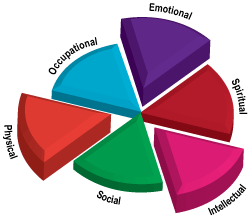
During the class this week, our needs were broken into 6 groups: creative, social, intellectual, emotional, spiritual and physical. Obviously, physical needs tend to be the most basic and if they are not being met, then it’s very difficult to even think of meeting the other needs. But if you have a roof over your head, enough food and an adequate amount of sleep, that means that you have 5 other areas to concern yourself with. So maybe you have trouble finding time for yourself or outlets that allow you to get some of these needs met. Don’t worry just yet. Why not take a minute, when the kids are sleeping or when you’re escaping for a minute to the bathroom, and simply list one or two things in every category that you would enjoy doing to meet your needs. Some activities or interests can even meet more than one. If you like to do yoga, that could meet a spiritual, physical and perhaps even social need if you take a class with other people. Some of these needs can even be met within the family unit. If you like to do art projects or crafting, why not do an activity that your kids could take part in as well? Thinking about your kids’ behaviors and reading blogs like this one may meet an intellectual need. There are plenty of ways to meet these needs. Some of them involve taking some time for yourself, but others can be met with the parenting trick of multi-tasking.

Again, don’t worry if you don’t know when you’ll have time to meet these needs for yourself. Thinking about and naming them is a good first step. You may find that you flex those creative muscles just trying to get your needs met while meeting those of your family. And if you want to do some more research about caring for yourself, take a look at Finding Definitions.

Can you find 5 minutes tomorrow for yourself?

I have confidence in me!

I listened to a lot of musicals growing up. A lot. In The Sound of Music, the fair heroine, Maria, attempts to bolster her confidence in moving from the nunnery to a grand house to look after 7 children by singing just that: “I have confidence in me!”

So I got to thinking: is the best trick to gaining confidence simply to sing about it? Tell yourself it’s so and magically, it is! Or is the way to gain confidence only through failing? Can slowing down and regaining your sense of balance also bring you confidence? I read a local Baltimore blog today that touched on these feelings of shakiness as they relate to parenting. I too have been feeling these wobblings in my self-confidence. Building a business is a daunting thing for so many reasons. Lately I’ve been feeling like I should sing my way up a mountain pretty soon just to convince myself that I am capable!

Parents need a confidence boost and so does the person who’s coaching them. Interesting. So how do we get one? I’ve heard singing for an answer. Anyone else? Faking it? Laying off the self-deprecating humor? Being kind to oneself? Perhaps confidence doesn’t come from how many proverbial balls you’ve got in the air and your ability to keep them there. Perhaps confidence comes from small successes in life. I’ve touched on helping children to build self-confidence in little ways, so maybe I should look to my own advice. Achieving small things tends to boost feelings of confidence in me (and in kids). When I can check a self-imposed responsibility off of my list, then I feel pretty good about myself for a little while. Maybe just performing our usual responsibilities is enough to make us feel confident in our ability to do more?

I guess I should really tackle my to-do list then and put one thing on it that will cause me to go outside my comfort zone. But once I complete that uncomfortable task, perhaps I’ll feel more like singing.

“I have confidence that spring will come again, besides which you see, I have confidence in me!”