I Thought Everything Would Change

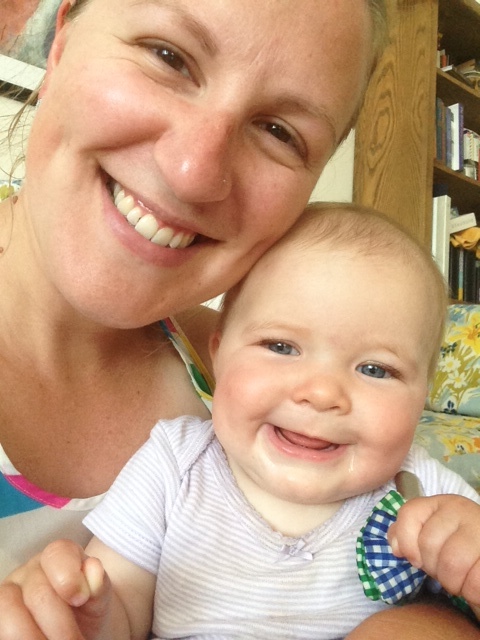
Mama & NoraWhen speaking with parents (prior to becoming a parent myself) about the ups and downs of life with kids, there was often an unspoken theme: You’ll understand once you have some yourself.

As a parent educator, who did not have kids, I always had to hedge my bets and say, “I can’t fully understand what you all go through as parents…”

There is a line that divides the “haves” and the “have-nots” because there is an overwhelming assumption that you just don’t get it until you’re a parent too.

So when I became a parent, I waited for lightning to strike. I waited to become different, feel more love than I’d ever felt before or hurt over someone else’s pain far more than my own. Then lightning struck in a different way, with the realization that I actually had had a pretty good idea of what it was like to be a parent even before I was one. Blasphemy! And even more, that I was still, fundamentally, the same.

I have read over and over again that there are no words to describe the Herculean task that is parenting. It is sooo hard and yet sooo rewarding. I’ve read how much people’s lives and views and priorities have changed. Plus there’s always the threat of never sleeping again!!!!

Since this is the overwhelming narrative of modern parenting (similar to the knee-jerk trite-ness of “Teachers are our real <underpaid> heroes.”), we basically all subscribe to it whether we’re conscious of it or not.

But I have some confessions to make regarding my pre and post parenting experiences.

#1 It’s never easy to listen to a kid cry, but it’s not so very different for me to listen to my own cry rather than someone else’s. I thought that there would be a magic string inside me that would get wickedly pulled when listening to my daughter cry. Turns out that that’s not true. The real reason that it eventually bothers me is because I hear it more often than I’ve ever heard any other kid cry.

#2 I thought I would love her more than anything ever when she was born. That’s what was supposed to happen, right? But that’s not what happened. A switch didn’t get flipped in me. I didn’t instantly understand, identify and embrace my new role as mother. I didn’t “fall in love” with her. My love for her grew over time and with care. But, it does not suffocate me. It does not eat me alive. I am not kept awake at night with love-filled worries and hopes for her. I love her, a lot, but happily for me, it has not entirely eclipsed my vision.

#3 Caring for and about any kid breeds the same kind of love that I feel for my daughter. It’s not different than love I’ve felt for other people’s kids. With added responsibility and connection, there is more of it, but it seems to be more of the same- not sparkly, magical, all-new love.

These revelations could seem sad to some folks, but I have to admit that I’m so glad to still have my center of gravity intact. I’m glad to still be me.

So while I am not trying to replace the adage of “You’ll understand once you have kids,” I’d like to add to it the possibility that your understanding might stay the same. And everything might not change for you like it’s been foretold.


Fighting the Fear

Concern for the safety of our kids is at an all time high. We worry about something happening to them that might hurt them. In order to prevent these “happenings” from…happening, we work to make our kids activities very ‘safe’. A possible result of this protectiveness is that we are raising more fearful kids.

I turned on the vacuum cleaner this morning while my daughter lay on the floor across the room. Her immediate reaction was…<scared face>! She thought about crying for a moment, while I reassured her that it was only noise. My initial thought was to turn the vacuum off and to make sure that she wasn’t afraid. Then I thought about what would happen if every time I turned on the vacuum, she cried and I didn’t vacuum. (Let’s be honest, it wouldn’t be too much different than now since the vacuum doesn’t get a ton of use) But I wouldn’t be able to vacuum when she was awake or then when she was asleep since it would wake her up. And eventually, I’d sell my vacuum and live in a dirty house. It’s not so important that I begin to work through her fears right this minute, but the longer that ‘irrational’ fears go unchallenged, the more cemented they become.

For example, I know a young man who used to be screamingly terrified of hand dryers in public bathrooms. At one point he would have rather wet himself than even enter a bathroom that had one. Because his fear had been left unchecked (and even encouraged), it became bigger and bigger until it became a problem for him to use a public bathroom. Uh oh. My fear eventually became that we’d find a hand dryer somewhere and a scene would ensue. Trying to control his environment so that he would not have to eventually face his fear only lead to more fear. The first few times that I warned him and then used the dryer myself, I just had to live with the echoing bathroomy screams that followed. But we practiced it often enough that eventually he became a bit more comfortable with them and at least wouldn’t run yelling from the bathroom if he saw one.

The general thinking is that if kids are afraid of something, they don’t need to do it. Depending on the circumstance, this can, of course, be true. If your child isn’t ready to jump off of the diving board at the swimming pool, that’s ok. Encourage them to jump from the deck into the pool first. Just as we eventually take their training wheels off of their bikes, helping them to face their fears, not avoid them indefinitely is a sign of maturity and growth- for both them and us!

If we let fear become the narrative and encourage it in our children by worriedly narrating their play with “Careful!” and “Watch out!” and “Ahhh! You fell down!”, we will be setting the stage for some entrenched fears and problem-causing scenarios.

We have to face our fears for them while they face their own fears.

I’ll never forget the day that hand dryers ceased to be the enemy. He was proud and so was I. Together we faced our fears.

This referee is on strike!

“Katie, he won’t let me play with him!”

“She won’t share her toy!”

“He yelled at me.”

“She took the game that I was playing with!”

After a few rounds of hearing this, you might just want to yell Enough! We’re supposed to be measured and considerate and helpful and perfectly patient when helping kids deal with their problems, right? Right. But if a lot of the problems that we hear about are small or divisive, then how should we behave? Should we always stop what we’re doing when someone comes into the room to report a hit and run (“He hit me and then ran away!”)? Should we always model how to solve conflict with appropriate words, while trying to make everyone feel heard? When is it ok for my patience to run out?

This happened to me just the other day. One kid came into the room with some tears to complain about a brotherly infraction (“He’s using my hideout!”). She wanted me to come into the other room and tell her “unruly” brother to get the heck out of the hideout! If she couldn’t control the situation, she wanted to find someone who she thought could. I stayed put and calmly talked to her about what she could do to try and get her point across. I asked her if crying and yelling was the way to get what she wanted. She sniffled and said no. I asked her what else she could try. She sniffled again and said “Say please.” After that, I wanted to leap onto the counter and yell, “You do know what to do! You don’t need me at all!” But I contained my excitement and listened to what would happen next. She left and used her words instead of her whining to try and kowtow her older brother. About 2 minutes after she left the room, her brother entered with the exact opposite complaint that she had (“She won’t let me play in her hideout.”). Every parent or caregiver has been in this situation. How can we make everyone happy? It takes real skills of diplomacy to enter into talks with young kids since the general answers are “Mine!” and “No!”. I thought for a second about what to do, because he was looking for the same thing as his sister. I want this adult to intervene on my behalf. She has the power to make changes happen! However flattering that is for me that I’ve been voted into the position of referee, it’s not always the most useful for them to have me solving their disputes. So I tried to stay out of this one as well. Since he’s a little older, I told him that I couldn’t always solve the problems that he has with his sister. He has to work to try to solve them himself. Probably not what he wanted to hear, but at least I didn’t have to get into a conversation about who had custody of said pillow hideout. He returned to the next room and they managed to work out a system of sharing the pillows but having two different neighborly hideouts. Wonderful! And all without too much adult interference!

Sometimes the best and most helpful thing for us to do is to hang up our referee whistle. Just like some fans get angry when there are a lot of penalties in a game (“Let them play ref!”), we should only call foul or intervene when it’s absolutely necessary. Oftentimes kids just need a reminder of how they can solve their problems without us stepping in to solve anything for them. I think that kids can do a lot more than we think they can, if only we let them play the game.

So, it’s official. I’m on strike.


What is ‘spoiled’?

The date on the milk says 9/4/12. Just two days past “good.” You sniff it to check it’s viability. It’s smells just a tiny bit funny, but you pour it on anyhow. Is it spoiled?

Milk metaphors aside, what does it mean for a child to be spoiled? Is it the age-old idea of giving them “too many” material things? Can it be something else? Is it something to be proud of? Is it something to dismiss? Is it an outdated term? Does it mostly happen for kids of wealthy parents? What is it? And if a child is conventionally spoiled, does that automatically mean that they’ll be a jerk as an adult? Once spoiled, are you spoiled forever? Does anyone believe that in the aftermath of Charlie & the Chocolate Factory that Veruca Salt grew up to be a nice person?

I don’t know the answers to all of the questions that I posed, but I have a few thoughts on spoiling and what it means today.

#1 Too many material things?

In our current American culture, acquiring things can seem like second nature to us. Even with economic troubles and worries, objects can “make us happier” and serve as status symbols. For many middle class parents, providing a rich and entertaining environment at home is a strategic goal of parenting. By flooding a kid with new and varied toys and objects, a child may come to expect that a) their wishes will be granted all the time and b) their toys should be entertaining them, with the real possibility of getting something new when they lose interest in something.

Besides giving kids an unrealistic view of the world (that material things are simply to be gotten, used, replaced and thrown away), providing them with too much doesn’t encourage long attention spans or imaginative play. It negates having a favorite object or toy, which can bring such comfort to kids. It also gives them very little sense of money. Kids don’t need to know all of the particular stresses and concerns that go along with money making and spending, but having an idea that it exists and that it’s not infinite will begin to give value to it.

Finally, buying buying buying simply makes more waste for the world. If we teach our kids that consumption is key, then the world of their adulthood will be littered with discarded and unwanted things.

#2 Spoiling in other ways

How do we spoil our kids without buying them things? And is this a real problem? I think that the overall idea of “spoiling” is that we are conditioning kids (or people) to expect immediate gratification and to expect that their environment will change to fit them rather than the other way around.

Parents contribute to these skewed ideas in a number of ways. First, by being too readily available to our kids, we give them the impression that being on the phone or talking to another adult is no reason for them not to have their wants attended to right away. Eh. Second, when parents work to control/change school or social environments for their kids when they meet an obstacle, kids are shown that if something is hard or unpleasant, they should simply give up or leave. If cries of “I’m hungry!” are immediately met with a snack, then we are teaching our kids that all they need to do is raise their pleading voices to get what they want. When parents create these expectations in their kids, they are setting themselves up to disappoint their youngsters when eventually they can’t control the environment or do need their kid to wait for something.

#3 Are you spoiled forever?

It seems to me that the answer to this is pretty straight forward: If you continue to expect the world to change for you, then you will continue to be “spoiled.” If you continue to expect attention to be paid to you on your terms, the same is true. The way to undo this is to come up against a real life situation when a teacher won’t let you do a make-up assignment or when you can’t continue to be the first in line. The world generally works to combat spoiling. It doesn’t work to change for us, it expects us to change for it.

So a little spoiling might not be the end of the world. It’s fun to break the rules sometimes or splurge on something at the toy store. But hopefully it’s not an everyday occurrence, else real spoiling could be the outcome. And once milk is on its way to being spoiled, it’s hard to stop it.

I want the world,
I want the whole world,
Give it to me now!

Things that are out of our control

I recently completed my first stint as a teacher of parents in the Positive Parenting Program at the Family Tree (which, incidentally, was the beneficiary of the Best of Baltimore party that took place earlier this month). The participants survived, as did I, and by the end of the class we were even sad to see each other go. Most of the anonymous comments that I received were positive, with only one that suggested that anything be enhanced for the future: me knowing more about inner city kids. At first I was a little embarrassed by this suggestion. But I’ve taught in two inner cities! It’s been a little while, but I know something about what kids and parent are facing in cities, don’t I? So I pondered this thought for the next day or two and I came to a realization. It’s not that I don’t vaguely understand the different parenting pressures in inner cities, it’s that I don’t have many ideas on how to parent if outside of your house and your control, your child is facing troublesome situations left and right. I was just avoiding talking about it. If you’re supposed to be good at giving parenting advice and you know very little in a certain area, then it makes sense to remain mum on that subject. Conundrum.

If you don’t want to talk about things that you’re unsure of, then you’ll never learn more to grow in confidence in these areas. We push our kids to explore the unknown all the time, in school and at home. But the comment that I received also translates to an overarching parental question: how do you do your best in situations that are out of your control? You can enforce the rule of “no hitting” when you’re at home with relative ease. How can you enforce it when your child is over at someone else’s house? Or even worse, when your child is getting hit on the playground and there are no adults around to see. What then? Should he hit back to defend himself? If finding an adult to intervene isn’t an option for your child, what should he do? What should you tell him? If your child attends a school that is chaotic or you live in a neighborhood with plenty of poor role models, what are the best things to teach your child for them to not only become a responsible citizen, but also for them to survive?

I think that these hypothetical questions (which aren’t hypothetical to so many parents in the U.S.) are what stumped me. I think that putting all of the responsibility to be good and prosper on the child makes it impossible for them to do so. I remember hearing a teacher speaking with a young girl many years ago when I was first getting my feet wet in the inner city. The girl’s parents were more than irresponsible. It was hard for her to get much sleep because there would be people over at all hours. Needless to say, very little positive care and attention was given to her. The teacher couldn’t change her home life and lack of positive parental involvement, so she took a different tack. She had a good relationship with this student, so she told her that it was up to her to get her homework done no matter what. If she had to do it under the covers with a flashlight every night before going to sleep, then so be it. The teacher couldn’t control some things, but she could use her positive influence over the student to encourage her to succeed. There’s no way that this can work for everyone though (and indeed, it doesn’t!). Shall we tell every child who is being negatively affected by neighbors or peers to simply buck up and do better? No matter that being different (especially “good” different) can make kids targets of bullying and excessive peer pressure.

So, are there no other solutions besides fundamentally changing our societal structure and making sure that all kids value good behavior, good education, politeness, respect and self-discipline? Easier said than done.

I’m still at a bit of a loss as to how to deal with parenting situations outside of my control. The best advice that I could offer was that by building up our kids and making them feel capable and strongly rooted, that they’ll take a coat of armor out into the world with them that will protect them from bad influence. This suggestion still puts a lot of personal responsibility on the child to resist and rise above. I guess that it’s the best I can do for now though.

Perhaps the moral of the story is two-fold: It’s ok not to know what to do or what advice to give. But don’t give up on thinking about it!