Blog

Teaching Kids to Be Cautious = Encouraging Risk-Taking?

When I came across this piece in the Guardian (Should I let my child take more risks?), I had already begun to think about the question of risk-taking for my own kid. There are plenty of reasons why kids should take part in active, sometimes risky, outdoor play (as this position paper also outlines): physical fitness, opportunities for socialization (!), learning self-control & body coordination, etc. And while I agree with all of these statements, I’m not quite ready to let my nearly 2-year old loose, alone in the woods just yet…

Plus, I’d like to add another dimension (albeit unscientific & un-researched) to this argument for risk-taking. I think it’s one of the best ways to foster caution, self-regulation and self-knowledge. What?! That sounds crazy! How can encouraging your kid to use a knife or climb up to reach something themselves teach them that?

Well, let’s look at it this way. How many times have you heard a parent say (or have said yourself) “Be Careful!”? It happens at the playground when your child is about to step on another kid’s fingers. It happens at home when they’re coming down the stairs by themselves. It happens when they pet the cat. It happens when they spin around and get dizzy. It happens when they’re running a little too fast down the sidewalk. Those words almost seem to have a mind of their own. They slip out of our mouths without us hardly noticing that they did. But to a young child, what do they actually mean? Hmm.

Instead of just saying those words, perhaps we should teach kids how to “take care.” Some of these lessons come directly from us and some of them come from their trials out in the ‘real world.’

From us: We can give them opportunities to dabble with “danger” in a safe environment. For instance, yesterday my daughter and I cut some eggplant for dinner. We both used serrated steak knives. Granted, she mostly ate raw eggplant and needed help cutting, but she had a knife. Ack! Before we began, I sat us both down at the kitchen table and had her touch the blade of the knife so that she could feel what “sharp” was. It was only our first experiment, but I think that she gained a little respect for knives from it. She was not eager to wield it wildly. She did not take it and run through the house with it. It did its job and that was it. She’s not going to be lucky enough to get a sharp knife with every meal, but it will make it’s appearance when it’s called for and we’ll continue letting her take that little risk.

Since we are preparing our kids for the real world, it’s important that we make their worlds as real as possible. There will be knives in the real world. There will be stairs. There will be stools to fall off of. There will be rejection. And there will be cats who might like to scratch. When we think our kids are ready, it’s important that we expose them to these realistic risks so that they can become familiar with them & get more comfortable dealing with them.

From the real world: Without us having to intervene, the world is already teaching our kids many things. If you fall down on the sidewalk, you’re likely going to skin your knee (and yet, we don’t all avoid sidewalks!). If you go outside without a coat when it’s cold, you too will be cold. If you climb up a rocky wall, you’re eventually going to have to climb down again. If you ask another kid to play with you, they might say no.

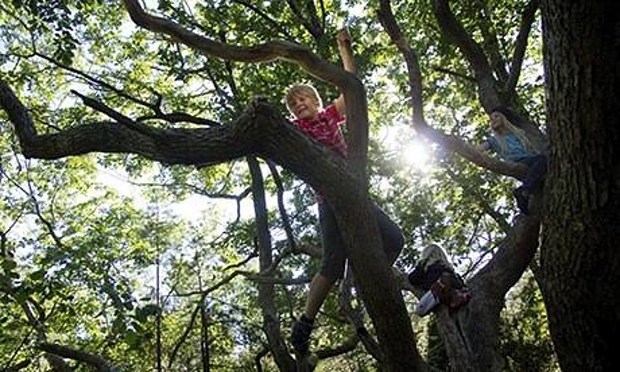
Letting kids experience the world (even in small bites like playgrounds) and push their physical and emotional limits is going to inform them of how much they can do on their own. They’re going to learn their own limitations and their own capabilities much more fully than if they are simply told what they can and can’t do without experiencing them. They will learn when they’re ready and able to climb to the next limb of the tree.

Limiting kids risk-taking experiences is only going to lead to recklessness or unnecessary fear: not understanding boundaries or viewing them as being everywhere. Caution and risk-taking, therefore, go hand in hand. I would also posit that it’s only kids who aren’t allowed to take risks or who are always rescued from them who don’t exhibit caution or self-regulation.

We can’t push them before they’re ready, but we also must not discourage them when they are. Encourage trying and emphasize that you’ll be there for a hug if they get hurt or are disappointed. But then allow them to take that risk again when they’re ready. It’ll be an endless exercise in vicarious risk-taking for us, the grown ups, who have already survived learning how to climb a tree.
Children-climbing-trees-008

The Social-ization Experiment

I have exhibited some hesitancy in sending my daughter to preschool. And I have casually brought up the future possibility of homeschooling. Both of these statements are usually met, not with fierce warnings or counsels against these choices, but with an accepting shrug and the quiet statement that both of these options might curtail my daughter’s opportunities to socialize. I don’t disagree that if we choose not to send her to formal schooling for a while that she will clock less time around her same-aged peers as other children her age. But I think that that isn’t the same as “socialization.”

In fact, I’m not even sure that I have a truly good handle on what the present-day definition of socialization is and why it has become such a buzz word in our culture today. At no other time in history (to my knowledge) have we been so worried about creating scenarios so that children can specifically socialize with one another. I understand that families and neighborhoods have become more scattered over the last century (as I sit in my air-conditioned house, alone but for my sleeping child), so we may have conceived this worry in response to that. But I would also contend that as parental focus on and the perceived importance of children has also risen, we have on our hands maybe the least “socialized” generation of kids ever. Don’t get me wrong, I still like them. But besides the usual ‘pleases’ and ‘thank yous,’ I have met many a kid who won’t or can’t greet me and others properly. It’s not hard to hear laments of a lack of manners especially from older generations witnessing the young. I’m not trying to throw stones at these youngsters. They are, in fact, still young and I have only met a few adults who seemed to have missed the entirety of “socialization lessons” of youth. But it does strike me as odd that in a time when we seem to be more focused on socializing kids, we also seem to be doing a worse job of it on the whole.

So I’d like to know when being a ‘citizen of the world’ became not enough to learn how to engage with other people. Why is it that in other countries without early formal schooling, there are not litanies of social pariahs being produced?

Kids learn to be social creatures (and are really born to be so, love that eye contact!) by being around people of all ages and walks of life. Segregating kids by age until they are thrust into a much more diverse workplace and world after 16 years seems to be a bit short-sighted. Yes, 2-year olds and 11-year olds should learn how to behave around each other, but they should also learn to behave out in the real world as well.

Taking kids to events that aren’t specifically tailored for them is a good place to start. Go to a concert with the whole family. Attend a sporting event that doesn’t have a bounce house attached. Go out to eat. Visit a museum. Talk to them about everything, not just ‘kid’ things. Expect them to address you with respect and it will be easier for them to do so with others. Let them play with friends with as little intervention from you as possible. Model for them the ways that you are there for your family and friends. Allow them to have their own relationships and interactions with other adults and family members.

I’m not advocating a complete disregard for this socialization movement, but I do think that there are plenty of very natural ways for our kids to interact with the world. We don’t have to simply put them on the conveyor belt toward ‘socializing’ and hope for the best.

The Luxury of ‘Childhood’: The Privilege of Innocence

On Saturday night, on the sidewalk at the side of my house, there was a fracas. One man was unhappy with and wanted something from another man, so he attempted to get it by force. There was a bit of yelling, a struggle and some attention from us and other neighbors. In the grand scheme of things, not a huge deal. They both walked away in separate directions, neither one hurt with no real bystander involvement at all.

In the crime reports given for my neighborhood at the monthly resident meetings, car break-ins, domestic disputes and drug activity are often the offenses mentioned. This might make some folks uneasy (and I must say, I was a little shaken by the ruckus this weekend), but as I sit here now, I can’t help but think that this tiny brush with “violence” is one of about 3 instances I’ve witnessed in my entire life. I thought about my daughter who was sleeping while this scene unfolded and how she, thankfully, has yet to experience anything like it, even after living in both Oakland & Baltimore for her nearly 2 years. Mostly, I didn’t want them to wake her up with their fuss.

And then, I thought of everybody else and their kids who aren’t so *lucky*.

For many folks, childhood is and was a time of magic and possibility, wonder and innocence. That little bubble is something to be cherished and protected. It seems a shame when kids start knowing a little too much or when they begin being realistic and more ‘adult.’ Adulthood comes with its perks as we all know (ice cream for dinner! no bedtime!), but there are some days when any adult might readily trade their life for a younger one without so much worry or stress.

The truth is though that there are many kids for whom this protected snow globe of childhood just doesn’t exist. There are plenty of young kids who have witnessed violence. There are plenty who are stressed by the situations in their neighborhoods, schools and homes. There are plenty who have seen the devastating effects of involvement with the police, the social service system and drug use. These very problems are no mystery to them. And for many of us, the privileged people who can afford to build these invisible boundaries for our kids, we would lament that the bloom has been rubbed off of their innocence far too soon.

I knew I was giving my kid a privileged upbringing already. I have the luxury (read: privilege) of staying home with her. I have been *blessed* (again read: privileged) to be able to take her to kid classes and fun activities during her little life. I am fortunate (ahem: privileged) that I can focus my energy on her and other interests in my life that don’t revolve around my feelings of environmental stress or anxiety. I’m lucky enough (…privileged) that I don’t have to worry about her general safety in our neighborhood (anymore than most Americans do living in this country of ours).

And I believe that most people would argue that every child deserves a childhood similar to hers. Every child deserves a period in life free from strain and stress, where innocence and play are all that’s required of them. But for many parents innocence means naïveté and naïveté means danger. So the childhoods of less privileged children, often minority, often poor, are truncated- some out of circumstance and some out of necessity.

It seems unfair that my husband and I can insulate our young child from the ills of the world while so many others don’t have that privilege. She can go on for a good long time, trusting us and the world that we encounter everyday. Because we both convey the same message: that she’s precious and acceptable and worthy of being taken care of. If only this were the message that every child received, while living in a safe neighborhood, in a safe house, blissfully unaware that their innocence is not a privilege anymore– because every child is privileged enough to be innocent.

I’ve Got the Power!

C’est moi qui décide!

So says one of my favorite tenets of Pamela Druckerman’s Bringing Up Bebe. “It is me who decides!”

Maybe I’m a little power hungry. Maybe I enjoy lording my position of power over my kiddo.  Maybe, but I do know that I want to be the authority in her life (along with my husband of course). I don’t want to cede my power to too many people or situations. I do want my daughter to have some power of her own, but in most situations, I want to have the final say!

Let me show you what I mean. Once upon a time I was on a bus in San Francisco. There was a mom and a kid sitting at the front of the bus. I didn’t hear any fuss from the kid, but the mom began telling the kid that he needed to sit down. She repeated this directive about a dozen times, growing louder every time (eventually it became clear that the mom was the one making the scene, not the kiddo). Since she did not feel that the child was heeding her, she began to up her game. She asked the kid if he wanted to get off the bus. She told him that the bus driver would have to stop if he didn’t do as she said. She said that the bus driver would have to call the police & they would have to come to address his misbehavior. Luckily my stop came before I could cringe anymore at her totally outlandish tactics.

This mom was needlessly giving her power away. She was not the authority for her child. She was trying to make other people be the authorities. Besides being very unrealistic (“Uh yes, is this 911? I’d like to report a non-compliant child. He just won’t sit down!”) and impossible to enforce, these ‘threats’ show your kids that you are not to be taken seriously. Maybe a police officer or the bus driver will be taken seriously, but not you. If you need backup (other than the united front that hopefully exists between your co-parent(s) and yourself), it might be time to double-down & become the authority that your kid needs you to be.

When visiting a friend’s house, they may say that it’s perfectly all right for your child to hang from the light fixtures. Great! Thank you! But my kid won’t be doing that because that’s not behavior that want them to exhibit no matter where we are. It’s me who decides!

While out for lunch with friends, your child reaches over to another’s plate and takes something without asking (this one just happened & I was not quick enough to catch it!). Your friend, very kindly, says that it’s quite all right for them to share with your kiddo. But you don’t want this behavior to become de rigueur no matter how kind the offer is. I say no to stealing from someone else’s plate without asking. It’s me who decides!

I don’t want my child’s behavior to be dependent on the “rules” of the surroundings. Yes of course there are certain places and situations that require or negate certain rules. But there are no places where it’s ok not to listen to me or to be rude or to whine excessively. And I’m the one who decided that!

Because I have the power! I have the backbone! I have the belief in myself & my authority! I have the ability to follow through! I say what I mean! I mean what I say! And I say that it’s me who decides!

Taking care of me (you!)

Just about every time I hire a babysitter, it’s so my husband and I can go to the movies. We don’t do dinners by ourselves very often or other grown up “dates” on our own (but, you know, 1 year olds aren’t very welcome at a 7:30 showing of the Avengers).

“But Katie, haven’t you said before that parents need time to themselves and time to meet their own needs?”

Why yes, dear reader, I have. But I have figured out ways to get that time to myself and to meet my own needs without having spa days or date nights. Impossible? I think not. How?

#1 I set our agenda

I’m the boss between the two of us (!), so if I’d like to go get a cup of coffee and watch people for a while, that’s what we do. Sure it isn’t always super relaxing, but the more often I take my kid to sit somewhere in public, the better she gets at it. If I feel like going to see some art, we go to a museum. She hoots around and I breathe that cool, arty air. Win-win.

#2 She naps

Today during nap (which is still going on), I watched a full hour of TV, made lasagna for dinner tonight, went to the bathroom, wrote in my journal and am now writing this post. Yesterday I slept pretty much the whole time she did. Her naps are my time to ‘play.’ She can clean up her toys when she wakes up. I’m not going to spend her nap doing her chores.

#3 I take care of myself even when she is awake

It’s not always easy to read my book or write when my dear one is awake, but I think it’s good to show her that her mom reads and writes! I don’t just switch into mom-mode the moment I hear her wake up. I’m not at her constant disposal as soon as she is cognizant. I can daydream. I can listen to music that like. I can give her a kiss and then keep taking care of me. Maybe she’ll even learn to take care of herself (and entertain herself) because of my “wonderful” modeling.

#4 I talk to my husband when my kid is around

We can all go out to dinner because my husband and I have/make ample time for ourselves to talk even while we’re with our daughter. We even occasionally discuss things that are going on in the world. My daughter learns that this is how grown-ups communicate & that this is what love looks like. She also learns patience since she’s not the only one involved in the conversation anymore. Even though she’s young, we ask her not to interrupt us (ha!), though this will take years for her to learn, we want her to start getting the hang of it now. Our talks and our adult relationship are just as important as our relationships with her. Plus I’ve known my husband way longer than I’ve known my daughter. He has seniority (in more ways than one).


For very busy people who don’t have much time to themselves, I totally get needing to have some time off from your kids. I’m not knocking date nights, but I do think that sometimes parents forget that we’re people too. We can choose the radio station. We can say ‘no thanks’ to playing legos if we’d like to catch up on some email. We can choose what’s for dinner. We can choose to go see the new Terminator movie (without kids of course)! Finding time for ourselves doesn’t have to mean allotting ourselves the 30 minutes after they’re in bed but before we fall asleep on the couch.

Take some of your time back for you even if it’s being spent with your kids. This can be what taking care of yourself looks like. It doesn’t always have to involve holding out until the sitter gets there.