Blog

You don’t know what you’ve got ’til it’s gone

I have a preemptive apology to make to the newest member of our family. Prior to this, I have been writing about hypothetical kids or other people’s kids, but now, I can write about my own kid. She’s not even 4 weeks old & I’m already taking advantage of her. Forgive me love.

And I begin where we are. She is napping right now, which is a perfect thing for a baby to do. But as many parents know, sleep + babies can also be a trial. There are a plethora of books written to help parents shape their children’s sleep (The Sleep Lady, Dr. Sears, No-Cry Sleep Solution, Dr. Ferber & many more). My little one sleeps about as much or more than my cat currently. And while she generally does ok on her own, it seems that if we miss the window of opportunity, or she gets over-tired, then her ability to go to sleep and stay asleep is lessened.

My husband and I have subscribed to our own set of sleep standards as outlined by Dr. Harvey Karp in The Happiest Baby on the Block. We swaddle our daughter, shush her, have her suck on a pacifier, put her on her side and rock her. According to Dr. Karp, she’s in her 4th trimester right now and would prefer to be back inside my uterus, so we work to recreate that snuggly, noisy atmosphere to help her feel more at home. I’m down with all of this mostly because it seems to work. But I will admit to feeling a little trepidatious about eventually weaning her off of these sleep helpers.

For instance, I’ve noticed that the more aids we use for her, the more she notices their absence when they go away. What does that mean? Well, if she is having trouble calming down, but is clearly tired, then we tend to pull out all the stops. Turn on the shushing app, pop the pacifier in, rock the cradle! These things tend to calm her down and help her eventually transition into sleep. The problem comes when the pacifier falls out or the rocking stops or the timer runs out on the shusher. When she’s disquieted from the get-go, she’s much more likely to continue to get upset if something goes missing. This is not true if she goes to sleep without this help. She only realizes what she’s got when it’s gone. On the other hand, if she falls asleep on her own without the white noise and without the soothie, then she sleeps better, longer and deeper. There’s less to go wrong, so less upsets her even while she sleeps.

So while the soothing sounds of the ocean help her get to sleep, they don’t seem to help her stay asleep most of the time. The same with the pacifier. It only helps until it hurts by falling out. I’m not swearing these helpers off by any means, but I do want to encourage sleep without help as much as I can since it simply seems to be more restful for her. And I do know that sleep begets sleep. If she’s not getting enough during the day, then she won’t get enough at night and all of us will need some soothing then.

Zzzzzzzzzzzzzzzzzzzzzzzzz
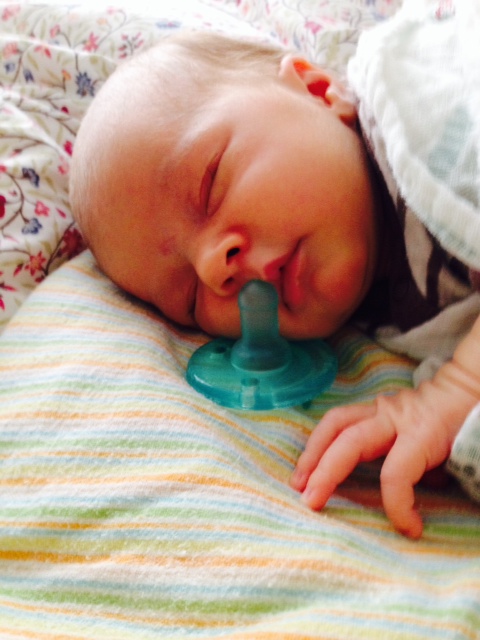
Nora zzzzs

Here’s looking at you kid

Eye contact. So useful. So powerful. So valued in our society. When people aren’t good at giving us eye contact, we assume there’s “something wrong” with them. We teach kids with social difficulties from the very beginning that eye contact is important. When emphasizing manners, looking directly at whoever they’re speaking to is underlined. Babies love it. We all love it. It makes us feel heard and indicates that we hear. It can express love, fear, disappointment, hope and so much more. And just like with every other powerful entity, we can use it for specific purposes (hopefully only using our “power” for good).

“Time to go to sleep,” you say. You’re watching your daughter intently for signs of fatigue and any indication that she’s not going to put up a fight, since it is, rightly, bedtime. She looks back at you with her eyes wide open, smiling. You gaze at each other for a little while, practically having a starting contest to see who will be the first to blink. You’re tired. You’d like her to be tired too. Sigh.

My first suggestion is that you use your eye contact to convey a message about this time of day.

#1 If you have a young child who has a bottle before they go to sleep, don’t stare at them while they eat. Keep your gaze soft and sometimes close your eyes. Looking into someone else’s eyes lets them know that they have an audience. It doesn’t necessarily mean that they’ll put on a show for you, but they’re more likely to try if they think you’re watching them.

#2 If you’re reading them a story in bed, lie down on the bed next to them. Don’t face them. Your eyes are paying attention to the thing that they should be paying attention to: the book.

#3  If you’re singing them a song or soothing them with some pats while they’re laying down, don’t look at their face so that they can see your eyes. I tend to look through my eyelashes a lot or simply put my head down on my arm to keep from looking at them (coincidentally doing a good impression of sleeping, which is what I’d like them to do).

“Mom, I need help with my homework,” you hear from the kitchen table. Another great way to use your thoughtful eye contact. When I’m asked to help with something school related, I often find that they’d like to shift a little bit of the responsibility to me. “Is that right?” Or they watch me to see if they can glean any information from my face about how they’re doing. “It’s this one…no, wait, this one?” And all of a sudden we’re lurching from guess to guess and getting it correct (quickly) becomes the focus instead of knowing how to do it.

How can eye contact be used in this scenario? Simply, I say unto you.

#1 If your child is asking for help on a problem and they want you to look at it or read it to them or take the reigns, don’t. Just look at the paper or the problem or the book. Sometimes you can read it aloud, but don’t always do so and then jump into an explanation of the problem. Just look at it. Act like you’re trying to figure it out (which happens more often than we’d like to admit). Keep looking at it. Look up at your kid for a second. Make a slightly questioning move with your eyebrows and then look back down. Hmmmmm….. The idea behind this is that you’d still like them to be in charge of their own homework. If you ask them a question about the homework and then watch them to wait for an answer…all of a sudden, you’re the one with the answers. You’re the one who has to be happy with the response. Not them.

#2 Once you’ve started working on whatever the “problem” is, keep looking down at it. You can encourage side by side concentration where you both work individually. That way, you’re still modeling that only by studying the problem or beginning to think about it can you ever reach an answer. The answer should not be found in your face. If that’s where they’re looking to gauge their progress, then they’re using their interpersonal skills to read your reactions, not their ______________ (math, spelling, reasoning) skills to come to their own conclusions. Don’t give them too much to look at- mostly meaning your eyes.

Sound doable?

You can use eye contact or the removal of it for many different situations without having to say much if anything.

“Stop doing that” say your eyes

Looking away to indicate that you’re ignoring a behavior that you see

Smiling at your kid

Winking

Surprise!

It’s quiet time

And so many more…

Here’s looking at you kid!

bogie

Preparing to eat my words

In about a month and a half, life is going to change for us in a big way. But also in the smallest of ways. We’re going to become parents. This occasion, for many, is exciting, anxiety-provoking, thrilling and stressful. I’m sure that like the billions who have gone before us, we will be overwhelmed and overjoyed. The one “problem” is that after so many years of dealing with other people’s kids, now I’m going to have my own to deal with.

And since I’m an “expert” at kid-dealing, this almost certainly means that I will be eating my words for breakfast, lunch and dinner.

I can picture it now:

Smarty pants bystander: “What’s your kid’s bedtime routine?”

Me: “Um…. I know we’re supposed to have one, but it’s hard to get her to go down around the same time every night. She doesn’t seem to like going to bed without a lot of help from me :/”

Well-meaning friend: “What’s the best way to deal with a child who won’t eat much? Ahem, your child…”

Me: “I once would have said, continue to fight the good fight and introduce them to more foods. After all, what’s for dinner is what’s for dinner. Now I just hope she’ll grow out of it and cut all of her food into the shape of a triceratops. It’s a grueling job, but it’s motivated by love (and the avoidance of conflict).”

Pre-parent Katie: “Katie, did you just give in to that temper tantrum?”

Me: “Shut up old Katie. You just don’t know what it’s like. When she was theoretical, you had it all figured out! But now she’s real!!!!!”

I’m well aware of this impending possibility. Part of me hopes that by admitting it aloud, I’ll magically avoid it and end up scoffing at my self-doubt. What’s better than proving yourself wrong when you’re doubting yourself? I knew I could do it all along!! Take that Katie!

But just in case, I’ve got my knife and fork ready.

eating my words headshot

It’s OK to be wrong

Have you ever caught yourself making a mistake and said aloud to no one in particular (except yourself), “Don’t be so stupid, Katie!” I know that I have. It just comes so naturally. Make a mistake: chastise yourself for it. Right now you might be thinking, “That’s dumb. Everyone makes mistakes.” Indeed, we all do.

My brother is an expert at this self-admonishment. If he makes a mistake that he feels ashamed of, he’ll smack his palm against his forehead, berate himself no less than 15 times and have some trouble moving on from the site of his mistake. Maybe he has heard other people (including me) do this to ourselves often enough that he’s picked up the habit too. I would argue that this isn’t a really useful way of solving problems or of making yourself feel capable of solving problems. So how should we change this “Doh!” attitude?

#1

Difficult as it may seem, we first need to police ourselves and how we narrate our own mistakes. If our kids hear us berating ourselves for doing something wrong, then they’ll think that that’s the usual response to forgetting to pack a snack or going in the out door.

#2

Try to replace your usual sarcastic, “Nice one, Katie,” with something a little more forgiving. When trying to bring my brother back from the edge of “I’m so stupid,” he can sometimes reframe his thinking into the much nicer, “It happens to everyone.” Having another phrase at the ready for those knee-jerk face palms can help you say something that you’d like your kids to hear you say to yourself.

#3

When you do make a mistake that affects someone else, apologize and move on. Whenever my patience gets short with kids and consequently, so do my words, I almost always try to apologize to them for my infraction. It’s up to them to forgive me, but I try to forgive myself after the incident. I try not to dwell or let any feelings of guilt affect how I treat them immediately after.

The same is true of kids apologizing for something they’ve done. Once they’ve apologized for whining or yelling at me, I work to forgive them and move on from it. I don’t want them to feel that they have to carry it around and show me that they feel badly for whatever they’ve done by calling themselves names. We don’t want them to do it to others, so why would we want them to do it to themselves?

Remember, it’s ok to be wrong & being kind to ourselves is an important example to show our kids.


Paris_Tuileries_Garden_Facepalm_statue

What?!

I walk into a room looking for a book. There is a kid in the room already. He immediately looks up at me and says, “What?!” I have two dichotomous mental reactions to this.

#1 What are you hiding?

And the more important…

#2 Does my appearance on the scene so often indicate an end to fun that it is often met with trepidation and suspicion?

Sigh. Maybe a little over the top, but it was made clear to me again recently, so I’ve been pondering it.

My brother is visiting us on his own for the first time. I picked him up from the airport yesterday to begin his one week stay. On the way home, he began fiddling with his many sets of headphones. If you’ve ever met him, you may understand his love of headphones. His collection is a point of contention at my parents’ house. He has so many and they get lost or broken often enough that his obsession with them can sometimes cause headaches for everyone.

As he fiddled, I noticed him sneaking nervous peeks at me while I drove. I kept my eyes on the road because I didn’t mind if he fiddled with his stuff (take it out, wind it up, switch it from hand to hand, put it back, repeat). But he’s pretty conditioned to be wary of his obsessive headphone actions. He’s used to being told that he can only bring one pair with him or to take them out while he’s walking somewhere, etc. So he was quick to say “What?!” to me if I looked at him because he was ready to be scolded.

I understand this reaction because I have elicited it in from a few kids in my day. Makes me wonder if a few too many of my interactions with them are to ask them to do or not do something or get ready to leave or put their toys away or boss them in some other way. I can understand why they would sometimes be suspicious of my entry. What?!

I’ll work to keep this in mind as my brother’s visit continues. I don’t want him to feel on the spot just because I look at him. I’ll try not to “check on him” and work to boss him a little less. He is on vacation after all.

who me?