Blog

Selfish Mom: Making My Life Harder Doesn’t (Always) Make My Kid’s Life Better

I self-identify as a selfish mom. I don’t know if there’s a club of like-minded moms out there or if I am an anomaly, but I try to confess this without too much pride or shame. I try to meet my daughter’s needs, but I also try to put myself first in most situations.

I’ve written about putting on my own oxygen mask first and a few months later, I think this idea still applies.

[cointent_lockedcontent]

One of the ways that parental love and devotion is measured in our American, middle-class world is in how much parents DO for their kids. We schedule play dates for our kids. We buy birthday presents for our kid’s classmates. We shuttle our kids to swimming camp, fencing lessons, Chinese tutoring and chess club. We make sure there are plenty of opportunities for learning experiences. All of this is great stuff! Who doesn’t want to know Chinese afterall? But all of it makes the “job” of parenting even more taxing.

In the same vein, if I am the family expert on everything, then I have instantly made my life harder by being the only one who knows where things are or how the baby is rocked “just so.” Ack!

But what’s the big deal with making our own lives harder? Isn’t that what being a parent is all about? Isn’t that parental love?

The first question for the over-scheduled family is: Is it more important for a child to have a head start in academics and activities OR is it more important that they have a less-stressed parent (and life)? When we add commotion to our own lives, we fill up our B.S. bucket more quickly every day. When it gets full, it spills on to whoever is near us- our kids, our partners, our friends. Making ourselves a little more crazy can inevitably make our kids feel that way too. They’ll start to feel always in a rush or always under pressure. Having felt those things as a grown-up, I would never want to hurry their introduction into childhood. Having a caring parent who takes an interest in their kid is more valuable than all the archery and music lessons in the world.

And for the parent who is the expert on family-life, your job is extra hard because you have to keep track of EVERYONE’S shoes, not just your own. You have to know what gear to pack into what bag on any given day. You have to know what child likes what food. You have to know whose chore it is to clear the table on Wednesdays. When you share your brain with so many other people, it’s difficult for you to keep any bits of it for yourself. This makes you the responsible party for everything kid related. If you always know where their shoes are, they won’t have to know where they are. If you always pack their bag, then they won’t have to know what to bring. You might think that you’re making your kid’s life better by making it easier, but they’re also being made a bit helpless by your ‘expertise.’

These are a couple of reasons that I’m going to try to watch out for me as much as I can as I continue down this parenting road. I am not planning on losing myself in my new role. I’m not planning on making my daughter’s life too easy by taking care of everything for her (even now, when she’s a baby). I’m not planning on forgetting the word “I.”

I know that plenty of this is easier said than done in the current parental landscape, but I’m going to try to remember that making my life harder isn’t necessarily going to be better for my kid.

[/cointent_lockedcontent]
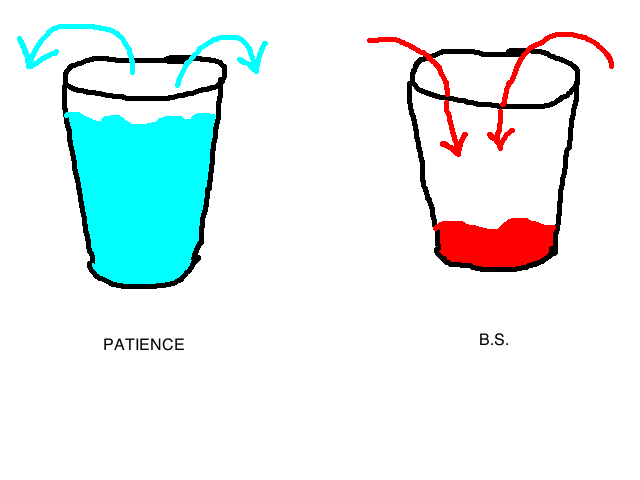
The Tale of 2 Buckets (One for Patience & One for B.S.)

Another day dawns, sunny and bright! Birds are chirping, coffee is brewing and YOU…feel rested! It’s a dag gum miracle. Since you’ve had a good night’s sleep, you feel like you’re starting the day fresh. Ahh. Your two buckets are just as they should be at the start of the day: one is filled with patience and one is empty of the B.S. that was collected in it the day before. The object of today: don’t end up with an empty patience bucket and a full B.S. bucket. patience & bs buckets

As one empties, the other fills. And if the end of the day finds you without any patience left and having had your fill of B.S., then the overflow from the yuck bucket will spill into the rest of your life. Your partner will feel it when they come home a little late. Your kids will feel it when they squabble over who can have the purple crayon. Your dog will feel it when she needs to go out while you’re in the middle of making dinner.

It’s a difficult thing to protect your daily amount of patience (which depending on the day, can start lower than we’d like). I’m not sure of the secret for making new patience throughout the day. My best bet at maintaining my patience is overestimating how long I will need it. I try to meter it so that it will last beyond my daughter going to bed, not just until my husband gets home. I attempt to conserve my patience so that I can do just about everything if I am called upon to do so. I find that if I am counting on relief and don’t get it, whatever is left in my patience bucket evaporates and my B.S. bucket quickly overflows (what a mess!).

It is difficult too to predict what trials and headaches will present themselves during your day to test your patience and raise your B.S. levels. Again, I don’t know how to keep one on the rise and the other at bay.  My thought is to keep an eye on how full each of your buckets is. It’s better to be aware of what’s coming than to be surprised when you reach the end of your patience bucket all of a sudden. Try to keep a little in reserve each day. And if you figure out how to turn B.S. into roses and rainbows, please let me know. I’d love to have the recipe.

And That’s My New Philosophy!

When I got involved in the parenting blogosphere a few years ago, I had no idea that so many other people had already thought to write about parenting issues. I was savvy even then.

So now it’s a couple of years in, I’ve read many a parenting book, taught parenting classes, had consultations with parents on what to do with challenging behaviors and I still am rounding out my knowledge base and my opinions. But I find a “new” trend to be a little alarming even though it has to do with people following parenting advice (which ostensibly I should love): having a parental philosophy.

Why the concern, Katie? There’s been a lot of chatter on the web about RIE parenting of late & “free-range parenting“, which both seem to be on the rise as a response to the ideas of concerted cultivation and attachment parenting (don’t forget “helicopter parenting”). I think that if you read my blog at all, you’ll be able to guess which way I tend to lean in this debate, but I’d like to take a different path if I may.

I’d like to make an argument for NOT HAVING A PARENTAL PHILOSOPHY.

I recently read a post defending RIE parenting and explaining it’s basic tenets. After having digested the <albeit> rather sensible information that I found there, I couldn’t get rid of one pesky problem with it. The author of the post cited herself as being an “RIE parent” and classified little ones as “RIE kids.” What’s the problem with that Katie? Defining yourself by the way that you parent leaves very little wiggle room for you to try something new. If you want to go off-book but know that it will be going against the rules, you might not break with your philosophy. But what does this matter if the philosophy is the best one around? I would wager that before our kids are parents, there will be even more, as-yet unthought of parenting philosophies. So who’s to say that any of them are the best? In fact, many who ascribe to a certain philosophy, much like religious fanatics, are truly convinced that there’s is the best (read: only) way to parent. As we more narrowly define ourselves, we make it harder to branch out, see others’ points of view and even grow personally.

I was recently informed of a play group being formed in my neighborhood with the intent of being a RIE space for kids to learn and develop in. Again, this sounds like an idea that I can get behind, but…I still have reservations. I like the idea that parents there won’t be hovering over their kids. Thumbs up. I dislike the idea that I have now entered a space that is so homogenous. We could all stand around and pat each other on the backs for not screaming when our kids tripped and fell (don’t get me wrong, I love a back-pat), but how is that depiction of the world realistic? The realistic world is that you’ll go to the park and your kid will fall and other parents will worry over her while you stay seated. If we try to recreate the world in the image of our philosophy, where will it end?

I’m not saying don’t have opinions or don’t read things or don’t like something more than something else <cough, RIE, cough>. I am saying that keeping an open mind is one valuable lesson that we’d like to teach our kids. Accepting other people and their ideas- another good one. Let’s tread lightly when we feel that our philosophy being threatened means that our way of life is being threatened.

If we all just loosened up our grasp on OUR PHILOSOPHIES(!), we might find that not having one is the best philosophy of all.

Frustration of Wants

How many times in a day might you say ‘no’ to your kids? I think it’s safe to say that they want a lot of things.

They want to poke the dog in the eye. They want to eat sweets until they feel ill. They want to stay up too late. They want to get up too early. They want to do anything besides homework. They want to do what they want to do…not what we ask them to do.

And, as parents, we work to keep these wants in check, hopefully teaching them not to be overtaken by them as they grow older (ala Veruca Salt).  Many parents think that having their wants “frustrated” by us is good for them. Our “no’s” are like vitamins for them. It helps them realize that they can’t have the world, right now.

On the other hand, parents find our wants are frustrated by our kids too.

We want to sleep in. We want some PEACE AND QUIET! We want to be able to poop without interruption. We want to have kids who love and respect each other. We want to have some adult time and freedom.

But we rarely view our kids’ actions as helpful to us in not letting us get too much of what we want. If it’s a good thing for us to teach them not to get what they want all the time, can it be a good thing for them to apply this same pressure to our lives?

Even if  we (parents) have kinds who always mind us and who always play well with others, living with them is still a continuous act of compromise. We work to have our needs met regularly, as well as some of our wants. And we work to meet our kids needs regularly and give them some of what they want.

It’s easy to think of kids as the thing that ended our lives of fun, our availability and our stamina. But we can also look at them as vitamins for us to help us figure out what we really need and rid ourselves of some unnecessary wants- just as we are the frustraters of their wants as well.

Attend-Ignore-Attend-Ignore

My daughter can sit up and reach for things. Woot. Braggin’! When we spend time with other kids who are around her age, she sometimes gets complimented on her skills. Recently, a mom jokingly told me that she was jealous and asked how I “got” her to do these things. I responded jokingly, but truthfully, “Neglect.”

neglect

As we continue to swing from one side of the parenting pendulum to the other, I find myself (surprisingly?) championing the idea of letting kids be. I like the balance that Catherine Newman seems to have struck in her NY Times parenting blog post, Give Kids Your Undivided Attention- Or No Attention At AllShe suggests that we fully attend or fully ignore our kids. And in these days of pushback to helicopter parenting (this didn’t used to be a bad word!), I think we all could use a little reassurance that letting go doesn’t result in a) our kids continuously getting hurt b) our kids never learning anything c) our kids not knowing that we love them- which were, perhaps, some of the worries that made us hover in the first place.

My daughter is sleeping now, so I can fully attend to my writing, but when she is awake, I often feel a guilty pull to be near her even while she entertains herself happily with her toys. Am I narrating her play enough? Will she hear those extra 30 million words when she’s young if I’m ignoring her? I work to watch and not intervene all the time. But it is often a conscious slow-down rather than my first instinct.

If we allow ourselves to name our computer time or reading time or phone time while our kids take care of themselves, maybe we’ll be more able to let ourselves off the hook. It’s not bad if I’m doing some computer work while she’s awake and around. It’s just better for both of us if I’m fully engaged in whatever it is I’m doing. That way she can get used to doing certain small things on her own, like reaching for her toys that have gotten away. When she knows that I’m not paying attention, she manages things for herself much better than when I’m present. When I sit down on the floor with her to play or watch her, she almost always needs rescuing from me when she didn’t before I got there. She “asks” to be picked up or repositioned. She whines for something she can’t reach. This is not to say that I am not going to spend time with her simply because she gets more needy when I’m around. But it does underline that her being on her own a bit is good for her, even at her young age.

My parents have often quoted the term “benign neglect” to me as the vague style of parenting that they used when my brother and I were young. So while I joke about my neglectful parenting, I think that there may be some merit to the idea.